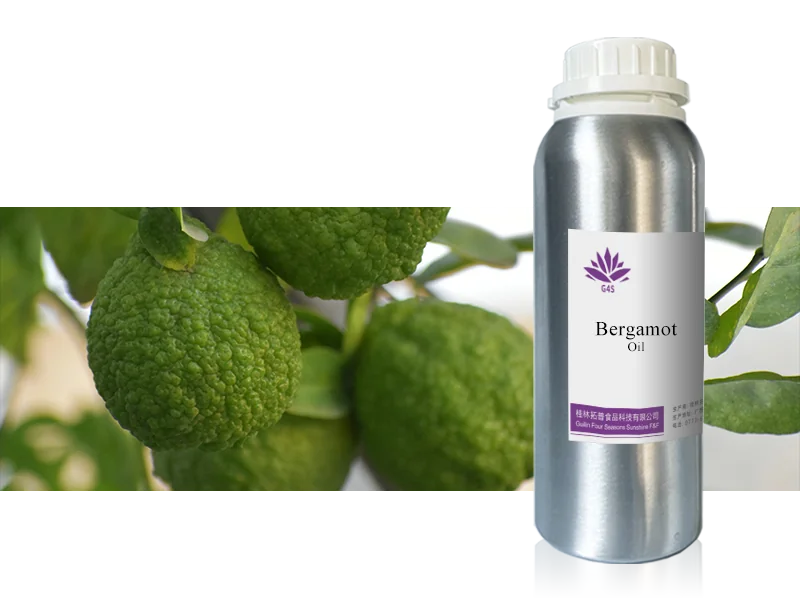
Which key aromatic compounds does this bergamot oil contain?
The characteristic aroma and quality of bergamot oil come from a well-defined ester/terpene profile, anchored by linalyl acetate — the compound that makes bergamot the finest of citrus oils.
Key Aromatic Compounds
| Compound | Typical range | Role |
|---|---|---|
| Linalyl acetate | ≥10% (ISO 3520:2022), typically 15-40% | Signature ester; the floral-fruity heart; key quality marker |
| Linalool | 20-30% | Floral, fresh top-heart |
| Limonene | 25-45% | Fresh citrus backbone |
| β-Pinene | ≤9.5% (upper limit tightened in ISO 3520:2022) | Terpenic lift |
| α-Pinene | small | Sharp top note |
| Bergapten / 5-MOP | regulated: ≤1 ppm for cosmetic FCF grade (EU) | Phototoxic furocoumarin, removed in BFCF version |
- Ester content expressed as linalyl acetate must be ≥36.0% in GB/T 14453-2008 and FCC 1996 (ester-value method)
- ISO 3520:2022 lists α-pinene, β-pinene, limonene, linalool and linalyl acetate as the GC fingerprint components
- The 2022 revision lowered the β-pinene cap and raised the limonene cap (25-45%) to reflect modern Calabrian oils
- Bergapten (5-methoxypsoralen, 5-MOP) is the main phototoxic substance; the EU limits it to 1 ppm in cosmetic finished products, so FCF/bergapten-free grades are standard for leave-on cosmetics
- Every batch ships with a GC-MS report confirming these components and their proportions
- Terpene levels vary with season and cultivar — one reason each batch is individually fingerprinted
Relate Products
This article was published on 2026-09-07, and last updated on 2026-09-29. The article will be continuously updated.