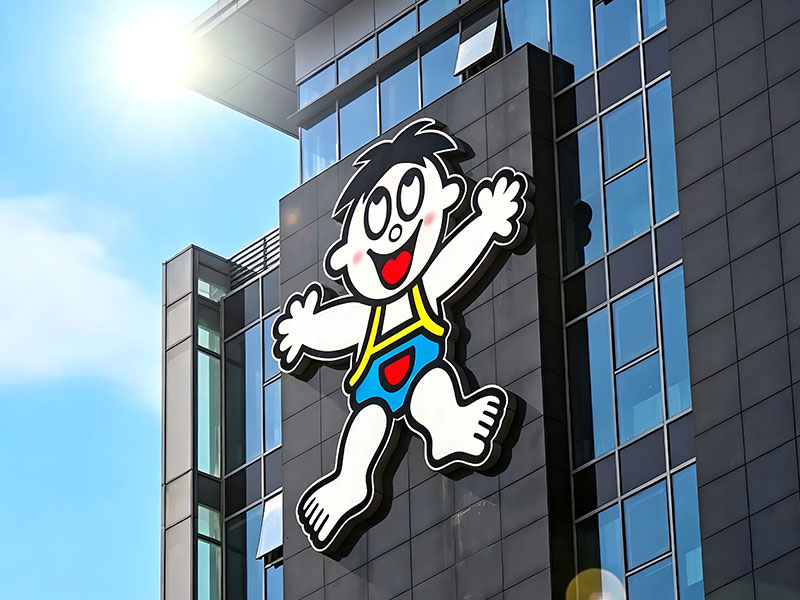
Things made for children are the hardest. An adult who tastes something wrong will say "this is a bit bitter" or "the flavouring is too strong"; a child says nothing, and simply does not take a second bite. Children's tongues are extremely particular: sweetness has to be enough but not cloying; the aroma has to be direct — you know what it is from one smell; no off-notes, and not the slightest trace of bitterness or astringency. Snow cakes, senbei, QQ candy, Lonely God, small steamed buns, Want Want milk — most of what Want Want makes is these things. The brand began in 1962 with a food factory in Yilan, Taiwan; the "Want Want" brand was created in 1983, working with Japan's Iwatuka Seika on rice crackers; it set up plants in the mainland in the early 1990s, and Want Want China listed in Hong Kong in 2008. Today its products sell in 77 countries and regions, and it has built the group's first large overseas plant in Tien Giang province, Vietnam. Its business philosophy is six characters: "affinity, confidence, great unity".
Rice crackers have very little aroma of their own — rice has hardly any smell, and the sweet note on a snow cake or the savoury freshness of a senbei comes entirely from baking and from what is added. Puffing and baking are high-temperature, low-moisture environments where aroma does not stay; you have to find a way to make it remain. What we supply to Want Want is the natural aroma materials for the rice cracker, confectionery and dairy lines. Doing these lines does not rest on any one technology being especially clever; it rests on stability that has not broken for decades — the same material made this year has to taste the same as it did ten years ago. That is easy to say and hardest to do: raw materials have good and bad years, the weather has drought and flood, equipment ages — holding the variation inside the range consumers cannot detect rests on retained samples, comparison and parameter adjustment, accumulated year by year.
What the two companies have in common is that both make things that several generations have eaten. Want Want snow cakes and Want Want milk were the taste of New Year for many people's childhoods, and now their children eat them too; on our side there are also old customers we have supplied for over twenty years — people have changed, packaging has changed, the material has not. A long business does not rest on any one batch being made especially well; it rests on not going wrong for decades. That also means pressure: if the taste of an old product changes, the consumer reaction is bigger than a new product failing — a bad new product can be delisted, but a changed old taste is remembered. So there is an understanding between Want Want and us: for the material of an old product, if it does not have to move, it does not move; if it must, run enough comparisons first, and it only counts when the panel cannot tell the difference.
The cooperation began with a classic product: the client wanted the aroma made more "right" — not stronger, but with the things that should not be there removed. The real hurdle came when going overseas. The same aroma type sold in Southeast Asia and sold in Europe and America faces different regulatory requirements — the permitted range of certain components, the limits, how it is written on the label, all differ from place to place. The first version of the material, made to domestic standards, did not pass review with the overseas client. Later we split the specification by market: one compliant version per market, with the main aroma kept consistent and the composition adjusted to local regulation. That split doubled the workload — each version has to be verified separately, sampled separately and documented separately — but it had to be done.
Talking about technology is clearest as three "must nots". The first: must not dominate. The aroma cannot cover the main taste — a snow cake is rice aroma, a senbei is savoury freshness; the aroma material is a supporting role, and that rests on aroma concentration pressing the dosage down: add less, enough is enough, because adding more steals the show. The second: must not leave anything behind. There can be no after-bitterness or astringency — children are most sensitive to bitterness and detect the smallest amount — and that rests on molecular distillation pressing down impurities and the components that bring bitterness, plus pushing refining depth up, so the finish is clean. The third: must not change. The taste cannot change across the shelf life — rice crackers are low in water but contain oil and easily turn rancid over time, so supercritical fluid extraction deals cleanly with the easily oxidised components and controlled release governs the release rhythm, so the first month does not burst and the last month is not empty. Hold all three and you get "the same taste for decades".
On supply, Want Want has several factories in China and is expanding overseas, and we supply them separately by plant to the same specification; the New Year season is the peak, so we build stock months in advance and do not let the client worry about waiting for material. On service, how much of the material is left after high-temperature baking and whether it has changed after half a year of storage is measured in advance and given to the client, rather than investigated after a problem appears; for children's taste tests we supply samples, packed to the portions the test needs. When the client's R&D comes to our plant, what is discussed is not price and delivery but "can this taste be a little better" — asking that question shows they are not planning to settle yet.
For the years ahead, what the two sides need to do together is clear: hold the taste of the old products inch by inch, complete the compliant versions for overseas markets, and work together on the health-oriented line — after sugar and salt reduction, how the aroma stands up is a question both sides have to think about together. For things that several generations eat, whoever makes them has to stay calm. Want Want has done it for over sixty years, and we want to keep doing it too.
This article was published on 2026-09-14, and last updated on 2026-09-21. The article will be continuously updated.