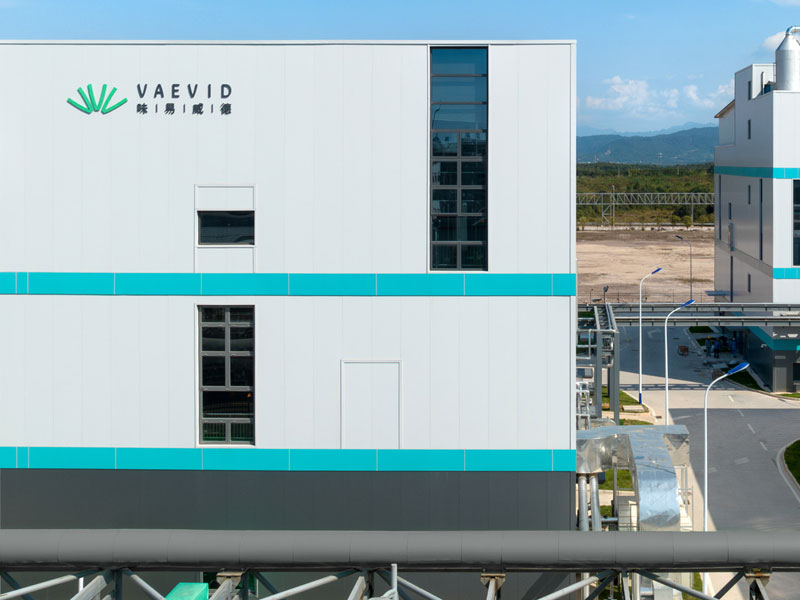
VAEVID's R&D people go into the fields. When the company says "go deep into the fields and seek unique flavour inspiration in nature", it is not a pretty phrase — finding a taste is not something you can think out sitting in a laboratory; you have to go and see what kind of slope that plant grows on, what season it is picked in, and how the local growers handle it. VAEVID was founded in 2007, with headquarters in Shanghai and a production base in Jiangxi. The Jiangxi plant was built to a high standard, using a self-developed cloud platform to manage production processes and flows — a new generation of smart factory. One company with half its people running into the fields for inspiration and half its lines on the cloud managing data — those two things look like opposite ends, but they are two sides of the same thing: turning what is unstable in the field into something identical in every batch in the factory. The stretch in between is exactly the work we do.
On the business side, VAEVID starts from four raw material tracks: natural vanilla, taken directly from the world's best vanilla origins; magic citrus, building layers into the whole citrus category; tea expert, a complete proposition built around tea; and coffee master, the coffee line. Three directions tie the business together: healthy living, putting health claims together with good taste; beautiful flavour, from local food culture to global taste trends; and sustainability, implemented layer by layer from product technology through production management to employee behaviour. What we entered is the most upstream link of the four tracks: the natural aroma materials and extracts needed by the vanilla, citrus, tea and coffee lines. The trouble with this kind of material is that it is "unstable by nature" — origin, vintage and harvest period all leave their mark. Our way of handling it is also direct: the process parameter curves of every batch are archived in full, temperature, pressure, time and flow all recorded, so that if a client wants a particular batch reproduced one day, it can be repeated one to one. Natural things cannot be exactly the same batch after batch, but they can be "the same in a way that can be checked".
Both sides understand the word "reliable" the same way: reliability is not never making a mistake, but being able to say clearly what happened the moment something goes wrong, to reproduce it, and to correct it. In this natural materials business, nobody can guarantee that nothing will go wrong in ten years — the weather is unpredictable, harvests have good and bad years, and equipment has its moods. What really loses a client is usually not the problem itself, but not being able to reach anyone when there is one, not being able to explain the cause, and not being able to fix it for next time. So between VAEVID and us there is an unwritten rule: good or bad, the news arrives first. If the aroma of this batch is a touch lighter than the last, the client does not have to discover it — we say it first, with the data and our own judgement attached. Do that often enough and trust accumulates — not accumulated through promises, but through speaking first, one time after another.
The cooperation began after the Jiangxi plant came on stream: capacity was up, and a natural material source able to supply steadily over the long term was needed. The real friction was on data. VAEVID is a digitally managed factory: raw material comes in and test data and batch information should go straight into the system. What we supplied at the time was a traditional paper report plus scans — the data was all there, but the format did not match, so the client had to enter it by hand, which was slow and easy to get wrong. It was not a big thing, yet it genuinely blocked us for months. Later we turned our reports and process records into structured data the client's system can read directly — one data package per batch, with test items, process curves and batch traceability information inside, imported by the client in one click. Only after that step did the rhythm of the two sides truly line up.
On the technology side, everything comes back to data in the end. For the natural vanilla route, what is needed is a complete aroma without distortion, which rests on supercritical fluid extraction — low temperature throughout, no solvent entering the process — keeping the components that change most easily under high heat. For the citrus route, the greatest fear is heat damage during processing, because the aroma changes as soon as it is heated; that rests on Living-Fragrance physical extraction, moving the plant's original aroma structure across intact by physical means with no foreign modification. For the tea and coffee route, what is needed is clean extraction of the actives and full flavour, which rests on dynamic multi-stage counter-current extraction — high efficiency, short time under heat, low loss. Varieties that need higher purity and stability pass through molecular distillation once more, combined with controlled release so the aroma releases steadily and lasts longer; where low dosage is required, aroma concentration enriches the actives so that usage is small and performance controllable. Along every one of these routes, data is left behind at every step — data is not a display for the client, it is the basis for making the next batch better.
On supply, we schedule to the delivery rhythm of VAEVID's smart factory: whatever day is agreed is the day it arrives, neither early nor late; with every shipment the data package goes across as well, and test items, process curves and traceability information enter the client's system together. Service is made solid too: when the client comes to audit, what we run is a digital traceability demonstration — tracing a drum of finished product backwards to the plot and the harvest date, with the parameters of every step in between available to pull up and look at; when the client's application engineers run bench trials, we follow the scale-up parameters for pilot and mass production all the way through. R&D people from both sides have also gone into the fields together and visited each other's origins and plants: seeing the same things makes talking a great deal easier.
For the years ahead, what the two sides need to do together is clear: make the natural material sources for the four tracks secure, press the variation between batches down a little further, and implement sustainability starting from the raw material end. Turning the taste of the field into a product that is stable in every batch in the factory takes someone working through it plant by plant, batch by batch. We have done that stretch for thirty years, and we are happy to keep doing it.
This article was published on 2026-09-14, and last updated on 2026-09-21. The article will be continuously updated.