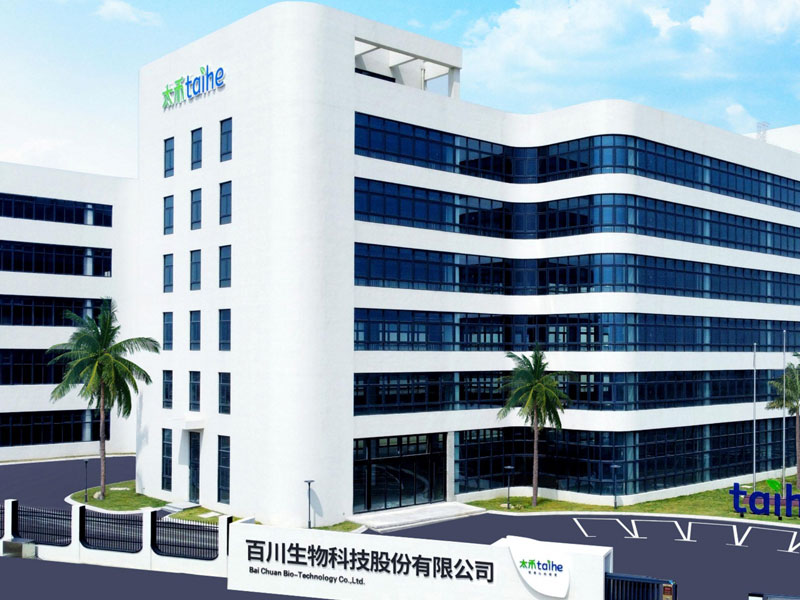
In the tea business there is a term: "returning the aroma". During extraction and concentration, the most delicate part of the aroma escapes along with the steam — the instant tea powder you get is drinkable, but it does not smell like freshly brewed tea; the layer on top is missing. The SCC extraction and aroma-return technology that UniBioche developed captures those volatile aromatic components and puts them back into the product. That one word "return" says everything about the difficulty of the tea beverage business: aroma runs away, and being able to bring it back is real skill. UniBioche was founded in 1999 by specialists from the tea science, food, nutrition and biochemistry disciplines under Zhejiang University's enterprise group. Headquarters is in Hangzhou; the team is small, some fifty people, but the technical density is high — eighteen patents specific to tea technology, a national high-tech enterprise, a Zhejiang provincial high-tech enterprise R&D centre, and a leading company in China's tea beverage ingredients field. Dealing with a small but specialised company has a particular feature: things are discussed directly, courtesies are skipped, and it starts with data and process.
The three capability blocks are laid out clearly. Tea refining: from garden management and primary and secondary processing through scenting and blending, with a complete processing and testing system. Tea extraction: seven technologies, each with its own use — microwave–infrared composite aroma enhancement, microwave-assisted circulating extraction, green tea protease hydrolysis, black tea enzymatic fermentation, SCC extraction with aroma return, CO₂ supercritical extraction, and kombucha fermentation. Tea beverage technology: solving colour protection, cold extraction, stability and industrialisation. Products include instant tea powder, matcha, tea pollen, kombucha fermented concentrate, natural tea and flower concentrates and extracts, organic tea, and natural flavours and fragrances. What we entered is the last part: natural tea and flower aroma materials used to supplement and lift the aroma of tea beverages. That job has a precondition — you first have to know what tea should smell like. We keep our own library of original samples: fresh samples, dried samples, comparison samples from different harvest periods are all retained. Whether a batch is made right is not a matter of feeling; it is compared against what the plant is like in itself.
The temperaments of the two companies are alike: both believe in technology, not in mysticism. UniBioche comes out of academia and talks patents, experimental design and data; we have spent thirty years in plant extraction and long ago stopped deciding by instinct — every parameter is recorded, every batch retained, every change made against a control. But both sides also know where the boundary of technology lies: instruments can measure composition, but they cannot measure whether this cup of tea is comfortable to drink. So UniBioche's tea tasters and the veteran masters in our workshop sit together more often than they sit with their own colleagues — one speaks data, the other speaks mouthfeel, and only together are they complete. We like this way of working: no need to convince each other, because each knows the other's half is right.
The cooperation began with one concrete problem: a tea beverage lost a great deal of its "freshly brewed" aroma after hot filling, and the client wanted it back. We could take that job on, because the difficulty was not in adding aroma but in what to add and how much. The real hurdle came afterwards — after the first version, the aroma was back, but it had been overdone: it smelled fragrant but tasted artificial, and the tea character was pushed down. That was a hard stretch: a little less and there was no effect, a little more and it was like a flavouring. In the end we ran a dozen or so gradient trials, evaluating group by group, and what we settled on was not "how much to add" but a range plus a ratio — how much of the top, middle and base aroma components respectively, so the aroma comes back without taking the tea's place.
Talking about technology is clearest by the three uses an aroma material has in a tea beverage. The first use is supplementing — putting back the top note lost in processing. That rests on Living-Fragrance physical extraction, moving the plant's original aroma structure across intact by physical means, with composition ratios close to the fresh raw material, so adding it back does not feel like an addition; combined with supercritical fluid extraction, low temperature throughout with no solvent entering the process, keeping the most heat-sensitive part intact. The second use is lifting — raising the overall aroma intensity a notch. That rests on dynamic multi-stage counter-current extraction pulling the actives out cleanly with short time under heat, then aroma concentration enriching them, so the dosage is small and the performance steady. The third use is stabilising — making the product lose less aroma across its shelf life. That rests on molecular distillation pressing down impurities and the components that spoil easily, combined with controlled release so the aroma comes out more slowly and lasts longer. These are not three choices of one; most of the time they are used together, with the proportions set by variety and process.
On supply, UniBioche's trial-production rhythm is fast and its specifications many, so we follow that: small batches, many specifications — a dozen varieties at a few dozen kilos each is accepted, and an order is not pushed to the back of the queue for being small. When parallel control trials are run, we split one batch into small portions so that every group starts from the same conditions and the trial data means something. Service matches it: composition data is supplied in full for the client to build formulation models; data needed for patent applications or technical documents is provided without holding anything back. Technicians from both sides have also run comparison experiments together in each other's laboratories, comparing conclusions on the spot — that kind of back-and-forth is worth more than ten meetings.
For the years ahead, what the two sides need to do together is clear: widen the range of natural tea and flower aroma material varieties, raise the efficiency of the aroma-return stage another notch, and make shelf-life aroma retention steadier. For a cup of tea to smell as if it has just been brewed, both ends have to push — UniBioche is responsible for keeping the aroma, and we are responsible for making it worth keeping.
This article was published on 2026-09-14, and last updated on 2026-09-21. The article will be continuously updated.