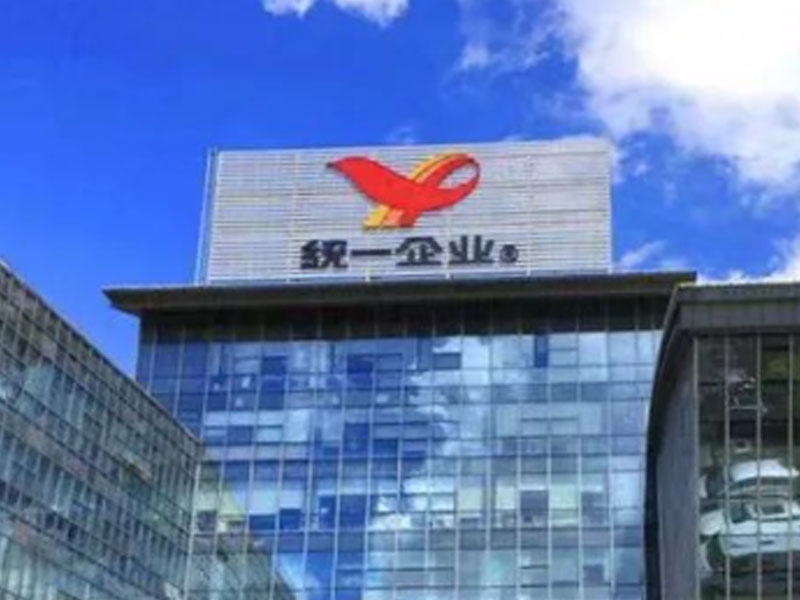
There is an old saying on the wall at Uni-President: "three goods and one fairness" — good quality, good credit, good service, and a fair price. That was the business principle set in 1967 when Kao Ching-yuan founded the company in Tainan, and it has not changed in decades. The words are plain; the hardest part to deliver is the last three: a fair price. Cheap is not the same as fair, and expensive is not the same as fair — fair means that after paying, a person feels it was worth it. Uni-President came to invest in the mainland in 1987, among the first wave of Taiwanese food companies, registered a holding platform in Hong Kong in 1992, and listed on the Stock Exchange of Hong Kong in 2007. Its brands are all familiar faces: pickled cabbage beef noodles, Soup Daren, Assam milk tea, Uni-President green tea, Uni-President iced black tea, and Orange More. In recent years Uni-President has also been doing one more thing — implementing the new national standard for prepackaged food labels ahead of time. Writing the label more clearly means that every single item on the ingredient list has to withstand being looked at.
That requirement travels upstream and arrives at us. If the label says "natural flavours and fragrances", then where those words come from has to be explainable — from which plant, extracted by which process, whether any chemical route was used. Our side happens to run a fully physical route, explainable and checkable: supercritical fluid extraction, Living-Fragrance physical extraction, dynamic multi-stage counter-current extraction, molecular distillation — no chemical modification touched along the way, so the natural character stands up. What we supply to Uni-President is the natural aroma materials for the tea beverage, juice and milk tea lines. Of the three, milk tea is the most troublesome: tea aroma and milk aroma have to be balanced, neither may dominate the other, and both have to be smelled and tasted in the chilled state.
Both sides understand "fair" the same way: not cheap, but worth it. We never fight price wars and never win orders by pressing prices, because pressing to the end always means saving out of the material — and whatever is saved out shows up in the taste in the end. We would rather work at the other end: raise the yield, extract the actives cleanly, bring the dosage down, so that every cent the client spends lands on the material. Same price, fuller aroma — that is what worth means. Uni-President's people do business the same way: they do not ask "can it be cheaper", they ask first "where is this money being spent". Someone who asks that is really doing the accounts, not haggling.
The cooperation began with an old product. The client wanted to make a tea beverage that had sold for many years a little more "right"; it used real tea extraction, but a good deal of the aroma was lost during processing. The real hurdle appeared later: this product had to come down in cost. Once the cost reduction reached a certain point, we tightened the natural material in the formula by one notch, and the cost did come down — but the aroma became thin: it still tasted like the same thing, yet the "thickness" was gone. Older customers might not be able to say what was missing; a trained panellist tastes it in one sip. That taught us something: cost cannot be saved out of the main aroma. Later we changed the approach: the main components were not touched at all, and space was found in the auxiliary materials and the dosage, using concentration to enrich the actives — less added, body retained — and only then did the cost genuinely come down without losing flavour.
Talking about technology is clearest by the cold and hot lines. Uni-President has hot-filled tea beverages and also juices and milk teas drunk cold, and what those two lines demand of an aroma is almost the opposite. On the hot-fill line, the material has to withstand instantaneous temperatures of over eighty degrees; the aroma must not scatter at that moment of heat, and the tea liquor has to stay clear with a returning sweetness. That rests on molecular distillation removing impurities and the excess heat-intolerant components, then controlled release letting part of the aroma survive the thermal process; clarity of the tea liquor is protected by refining depth, with insolubles pressed down so it does not turn cloudy over time. On the chilled line, the difficulty is low temperature — aroma does not come out when cold, the same principle as making ice cream — and that rests on concentration plus fractionation, raising the proportion of the components that still volatilise at low temperature and have low thresholds. One line fears heat, the other fears cold; the methods are opposite, the principle is the same: the aroma has to come out when it should.
On supply, Uni-President has plants in East, South and Central China, and we supply them separately to one specification, so whichever plant receives it, it is the same; before each year's peak season we build stock in advance rather than waiting for the order to schedule production. On service we take one more step: how the material performs in the client's actual process is measured before we quote — how much is left after UHT, how much is lost after hot filling, whether anything remains after a week of refrigeration — the data goes on the table first so the client knows where they stand; and when the client runs a cost-reduction project we look for solutions together rather than simply cutting the price, examining which part of the formula can be optimised. R&D people from both sides have also spent nights on the client's production line running trial production, adjusting parameters on the spot afterwards.
For the years ahead, what the two sides need to do together is clear: write those words on the label with more confidence, take the flavour of the old products one notch further towards "real", and walk the cost-reduction road a little more cleverly. Whether it is worth the money is decided by the person drinking it — that sentence has hung on Uni-President's wall for decades, and we believe it too.
This article was published on 2026-09-14, and last updated on 2026-09-21. The article will be continuously updated.