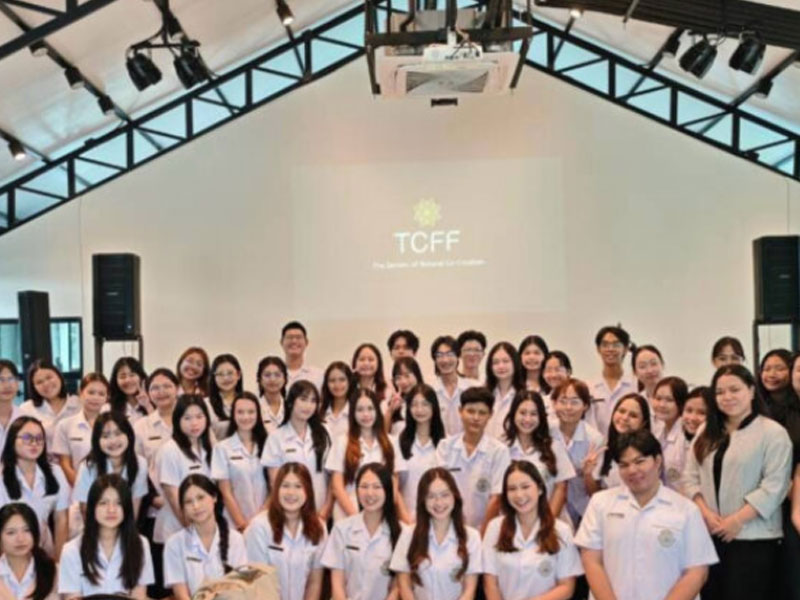
Ayutthaya and Chiang Rai in Thailand are not far from Guangxi on the map, and the latitude is not very different either, so a lot of what grows is the same kind of thing: mint, lemongrass, ginger, basil, patchouli. The climate is close, the crops are close, and yet what each produces has its own temperament — the same plant grown in red soil and grown on karst hillside can differ by a whole layer of aroma. TCFF was established in Thailand in 1988 as the first company in the country to bring natural essential oils to industrial scale. There was no precedent for that at the time, so equipment, process and cultivation standards all had to be worked out from scratch. Over more than thirty years TCFF has grown from single essential oils to five product lines — essential oils, fragrances, aromatherapy, food flavours and natural extracts — with a factory in Ayutthaya, agricultural research centres in both Chiang Rai and Ayutthaya, and shared work with local growers to raise cultivation standards. In recent years TCFF has also done something interesting — a co-creation service that lets clients take part in the blending themselves: "make your own scent".
TCFF's confidence rests on vertical integration: from agricultural research and raw material cultivation to finished product manufacturing, the whole chain is in its own hands. That is something we find especially familiar, because we work the same way — not buying material in to extract it, but managing our own bases, choosing our own varieties and tuning our own processes. Knowing how it will be extracted at the time it is planted, with selection, breeding and extraction decided by the same group of people — the benefit of that is invisible to outsiders: whether a variety suits essential oil production is not known after harvest, it is decided when the seed is chosen. But there are also clear areas where the two do not overlap. Differences in climate zone determine differences in variety: what grows well in Thailand and cannot be grown here, we do not make; and conversely, what we have and Thailand lacks becomes the reason for the two sides to trade. What we give TCFF is exactly those few varieties that are not produced in Thailand or are produced in insufficient quantity — not fighting over the same bowl of rice, each adding a dish to the table.
There is an advantage to dealing with a peer: a lot does not need to be spelled out. Talk about yield and you do not have to explain why this batch is low; talk about composition and you do not need to say which peak is what; talk about the weather and one sentence is enough. There is also a "disadvantage": neither side can try to fool the other. TCFF came up through essential oils; given a batch of material, a smell and a look at the chromatogram are enough to know roughly which route the process took and around what range the temperature was held — the hardest kind of customer to deal with, and the fairest. We like this kind of relationship: a peer is a mirror, and the faults picked out are usually real faults. Looking back at the comments TCFF has made over these years, almost all of them were aimed at the right place.
The first cooperation was plain: TCFF was short of a variety, we happened to have it, a sample went over, and it worked. The real friction was in harvesting. For the same variety, the two sides judged "when to pick" differently — Thailand followed its own phenology and harvesting habits, we followed the standards on the Guangxi side, and as a result the composition ratios of the material did not match and the aroma went in different directions. That is not a matter of who is right; it is decided by the climate of the origin. That year we laid out both sides' harvest records and composition data and compared them, and in the end settled on a method both could follow: divide maturity into several grades, each grade corresponding to a harvest window and a composition range, and write into the specification which grade is wanted. From then on, the same variety comes out matching no matter which side makes it.
Talking about technology is easiest by variety, because different varieties take different roads by nature. Flowers and heat-sensitive material go through supercritical fluid extraction — low temperature throughout, no solvent entering the process, so the most delicate part of the aroma survives. Leaves and peel go through Living-Fragrance physical extraction, moving the plant's original aroma structure across intact by physical means with no foreign modification, aiming for "as if just picked". Roots, woods and seeds have hard fibre and give up their content reluctantly, so they go through dynamic multi-stage counter-current extraction, pulling the actives out cleanly while keeping the time under heat short. A few varieties with requirements on colour and impurities pass through molecular distillation as well, raising purity and pressing colour down. For blends and low dosage, aroma concentration enriches the actives so that usage is small and performance steady. These routes are not fixed; which road a variety takes is decided by both sides together.
There is understanding on supply as well: material for TCFF is made to the specifications TCFF's line is used to — concentration, solvent system and packaging all follow the other side's habits, so there is no need to change a process for our material; the two sides also exchange varieties, each making what it does best, and do not force a collision on the overlapping part. Service, in the end, is peer exchange: when TCFF's people come to the plant, we open up the process parameters and explain them, including the places still being changed; the two agricultural research centres have exchanged cultivation data and seedling observation records, and these things outside the business are actually the most substantial of all. The principals of both sides have walked the fields together, talking about this year's rain and harvest rather than orders.
For the years ahead, what the two sides need to do together is clear: go through the list of complementary varieties once more, bring the cultivation standards of both sides closer to one set, and make the co-creation service real — so that TCFF's clients can choose material from Guangxi when they blend. Peers are not opponents. Each occupies a stretch of climate zone, and together they make a full year of supply.
This article was published on 2026-09-14, and last updated on 2026-09-21. The article will be continuously updated.