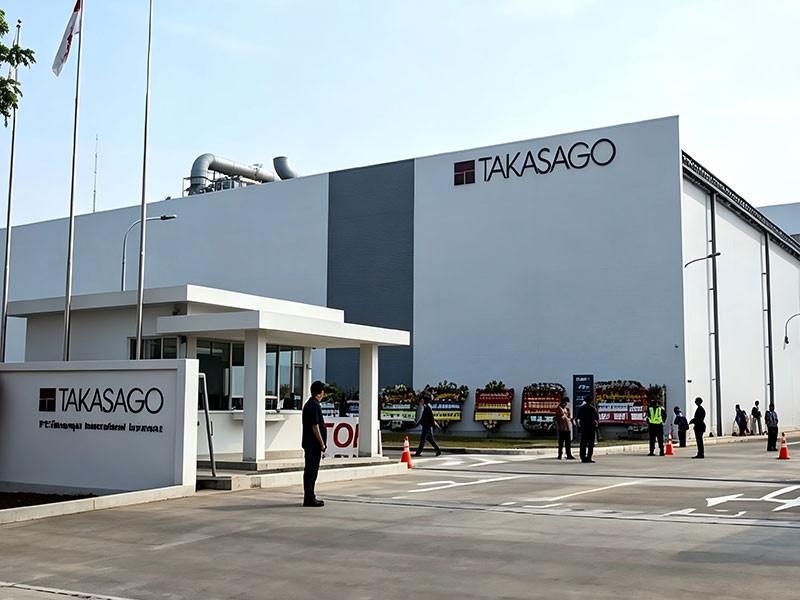
There is an interesting contrast in this industry. Japan's largest flavour and fragrance company started out on natural raw materials like mint and camphor; a hundred years later, what made the company known worldwide was a synthetic technology. Takasago Perfumery Industry, founded in 1920, is headquartered in Kamata, Ota-ku, Tokyo, listed on the Tokyo Stock Exchange (code 4914), with three business segments — fragrance compounds for personal care, flavours, and fine chemicals — and subsidiaries, factories and R&D facilities across Asia, Europe, the Americas, the Middle East and Oceania. In 2001, researcher Ryoji Noyori of the company won the Nobel Prize in Chemistry for his pioneering work on asymmetric catalytic synthesis — a flavour and fragrance company producing a Nobel laureate, unique in this industry. Takasago is also one of the few companies able to work in synthetic aroma chemicals, natural materials and finished fragrance compositions at the same time, and beyond its own use it supplies aroma materials to peers around the world.
The first impression of dealing with Takasago is thoroughness. Japanese companies have many rules: one technical email copies a whole string of people, a parameter change has to be confirmed in writing, samples travel with a specification sheet, a test report and a retained-sample number. In the early days our workshop found it hard to adapt — even changing a temperature meant waiting for a reply, and when you are in a hurry that is genuinely frustrating. Only after working together longer did we understand that the slowness buys stability later in mass production: when the upfront confirmations are complete, the production stage almost never goes wrong. Takasago has another characteristic: it understands both synthesis and naturals, so its judgement on a natural material is not "natural is better", but whether this particular aroma deserves to be made the natural way. Where synthesis should be used, synthesis is used; where naturals should be used, naturals are used. The line is drawn clearly.
The business has three parts. Fragrance compounds for personal care serve fine perfumery, cosmetics, personal wash and home and fabric care. Flavours cover beverages, dairy, confectionery and bakery, savoury, and health and nutrition. Fine chemicals are led by L-menthol, alongside fine chemicals for pharmaceutical and electronic materials. There is also the aroma materials business, developed and produced in-house and sold to peers as well. What we connect to at Takasago is exactly that aroma materials layer, and specifically the naturally sourced part of it — not the formula, but the material the formula is made from. Takasago is a specialist in aroma materials itself, so its eye is naturally demanding. The reason we hold our place is quite simple: others source their material in the market; we start counting from the soil. The aromatic crops and botanical resources of Guangxi, plus extraction, separation and purification in our own hands, mean that which plot the material came from, which day it was picked and which process it went through can all be traced backwards.
Over the years with Takasago, there are three things we genuinely admire. First, taking fundamental research seriously: a researcher can spend decades on one path like asymmetric synthesis and the company is willing to keep supporting him — not everyone has that patience. Second, keeping the boundary between natural and synthetic clear: it does not romanticise naturals just because its own synthesis is strong, nor does it run synthesis down because it also works with naturals. What suits the occasion is chosen, and the argument is reason, not position. Third, solid documentation: a question is chased to the end and no vague ground is left. What Takasago values in us, we roughly know as well: first, everything from raw material to finished product is in our own hands, so changing a parameter does not depend on anyone else's mood; second, when there is a problem we really go to the site — to the base, into the workshop — rather than only explaining over email; third, thirty years of foundation means we have seen the changes in natural materials over these years. In the end, a company that understands both synthesis and naturals does not need to hear "we are natural too"; it needs a partner who can explain the natural side clearly and execute it solidly.
At the beginning we only took sporadic volumes, small enough that they did not justify a production run. Those written procedures mentioned above were genuinely grinding in the first year: one parameter change needed three rounds of confirmation, the workshop was waiting to start, and we were caught in the middle. Later both sides sat down and went through the process, drawing a line between what had to be confirmed in advance and what could be done first and documented after. Only then did the rhythm settle.
What really brought the relationship close was one joint effort. One year Takasago needed a variety where the front of the aroma was good but the back fell away after processing, and stability testing would not pass. We ran three rounds back to back. In the first we pushed the extraction temperature down; the aroma held but the yield fell to nothing worth looking at. In the second we changed the route; the yield came back but the aroma scattered. In the third we laid a base of physical low-temperature extraction and then added molecular distillation and controlled release, so the aroma released steadily and lasted longer — and that got it through the stability test. During that stretch the technicians on both sides were on the phone almost every other day, and data went across the same day. Looking back, the solution we found that time later became our standard practice.
The technology we hold is just these few things. Living-Fragrance physical extraction moves the plant's original aroma structure across intact by physical means. Aroma concentration enriches the effective aromatic fractions so that dosage and effect are both controllable. Dynamic multi-stage counter-current extraction runs several stages against the flow, raising efficiency and lowering loss. Supercritical fluid extraction is low temperature throughout, with no solvent entering the process. Molecular distillation and controlled release take purity up another notch and make the release steady and long-lasting. Purity, colour and aroma stable over the long run, and a batch sent a year later still matching the same reference sample — those two sentences are what Takasago values most.
On supply, a safety stock is kept year-round so a sudden increase from Takasago does not break the chain; one line can run several varieties, and there is a standard procedure for changeover and cleaning. On service we do two things on our own initiative: once a year we send a full set of external testing, with the report going straight to Takasago's quality department; and Takasago can come to the plant without notice and walk the site at any time. When a new project idea appears, Takasago comes to us first to compare notes; when we get a new process running, we are happy to show Takasago first.
For the years ahead, both sides want the same things: joint development of several natural varieties, further optimisation of process parameters, further completion of sustainable sourcing documentation. Takasago has a complete system from fundamental research to mass production and a global customer network; we have thirty years of extraction craft and the raw-material land of Guangxi. Each brings what it has, and together there is more we can do than either could alone.
This article was published on 2026-09-14, and last updated on 2026-09-21. The article will be continuously updated.