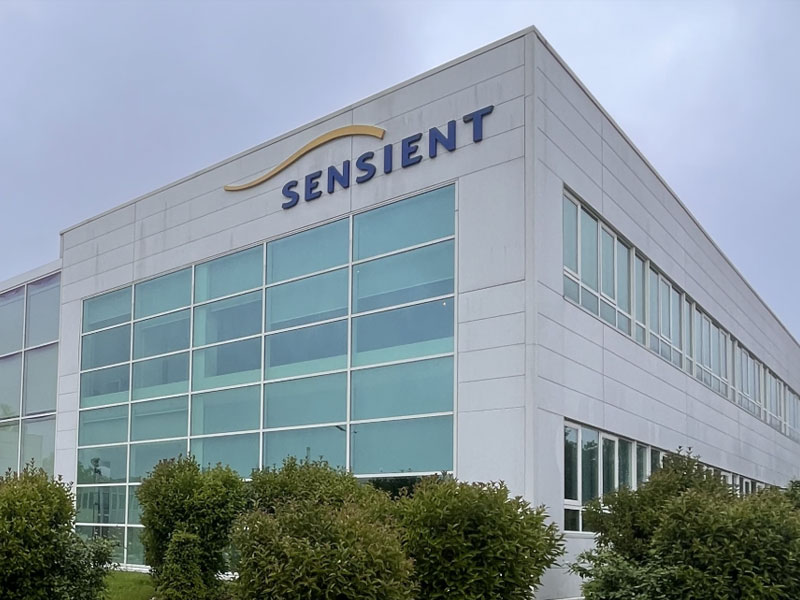
Sensient's business is built on one fact: the eye is faster than the nose. Before you smell something, you see its colour — a drink is set down in front of you, the colour decides what taste you expect, and only then does the nose speak. Sensient was founded in the United States in 1882 and started out in food colours and extracts; more than 140 years later, colour is still the deepest background of this company, with aroma added as a later layer. Today Sensient is headquartered in Milwaukee, Wisconsin, listed on the New York Stock Exchange, with annual revenue of around USD 1.5 billion, around 4,000 employees worldwide, production sites and sales offices in North America, Europe, South America, Asia-Pacific and Africa, and business covering more than a hundred countries and regions. Work with Sensient long enough and you notice one habit: while talking about aroma, Sensient's people will also ask about colour. That habit ended up changing one of our processes.
The business divides into four. Colours: natural and synthetic colours for food and beverage, and for personal care and industrial use as well. Flavours & Fragrances: food and personal care lines run in parallel, covering beverages, dairy, confectionery and bakery, and savoury foods, as well as perfume, cosmetics, personal wash and home care. Aroma ingredients and extracts: natural essential oils, aromatic extracts and plant-based aroma materials. And Asia-Pacific and specialty ingredients: food ingredients and specialty products for the Asia-Pacific market. What we entered is the third — the natural aroma materials strand. The common knowledge in this trade is that aroma materials almost always carry colour. What comes out of a plant brings colour and aroma together, and most of the time nobody treats the colour as an issue, because the downstream side adjusts it themselves. Sensient is different: Sensient is the one who fixes the colour for the client, and the little bit of colour an aroma material carries in is "negligible" to others but "has to be counted" at Sensient. That is something we only really started managing as an indicator after working with Sensient.
The characters of the two companies are actually rather different, and complement each other well. We take the craftsman's road: a veteran master smells a batch, looks at it, and knows where it differs — thirty years of nose and feel, hard to explain but accurate. Sensient takes the engineer's road: everything goes onto a scale, sensory profiling, descriptive analysis, statistical treatment, aroma broken into dozens of descriptor terms each scored separately, colour measured to ΔE. At first glance the two roads do not get along — we thought they were too exacting, they thought we were too mystical. But as the work went on it turned out that the two sides were doing two halves of the same thing: feel finds the problem, the scale says where the problem is and how large it is. Now, after our master evaluates a batch, he goes and looks at the gas chromatogram himself; and when Sensient's evaluators come to the plant, they follow the master to the tank for a smell.
The first contact happened at an industry exhibition, where someone from Sensient asked a very specific question at the stand: of this material's aroma, how much is left after three months in an acidic beverage system. Not many people could answer that question at the time. We kept the data, went back and ran a round of accelerated testing before replying, and the cooperation began with that one question. The real hurdle came on the first shipment: the aroma fully passed and purity was beyond question, yet Sensient came back saying "the yellow in this drink is a little off" — it was not that our material was faulty, it was that a normal colour value still counted inside Sensient's system. Until then we had treated aroma and purity as the indicators and had never managed colour as one. Over the next few months we added a decolourisation step and made colour a controlled item as well: measured on every batch, written into the report, held inside a narrow band. After the change, Sensient no longer had to leave room for the colour of the aroma material when adjusting shade.
Talking about technology can start from the roads we do not take. The first is high-temperature steam distillation — heat-sensitive aroma components are mostly gone after that pass, and what comes out is "flat", missing the layering the plant had. The second is organic solvent extraction — the yield looks good, but the tail of solvent residue cannot be shaken off, and Sensient is particularly sensitive on that item. What we take is another road: supercritical fluid extraction, low temperature throughout with no solvent entering the process, aiming at "not detected"; Living-Fragrance physical extraction, moving the plant's original aroma structure across intact by physical means rather than assembling it with foreign modification; dynamic multi-stage counter-current extraction, pulling the actives out more cleanly while shortening the time under heat; molecular distillation, taking purity up another notch and pressing impurities down, combined with controlled release so the aroma releases steadily and lasts longer; and aroma concentration, enriching the effective aromatic fractions so that dosage is small and performance controllable — added into a system it neither harms clarity nor carries much colour in. Together these roads answer the question Sensient asked at the very beginning: how much is left after three months.
On supply, we hold buffer stock for Sensient so a sudden additional order can still be taken; the same variety is made to two specifications — an aroma-first version and a light-colour version — so Sensient chooses by end use rather than using whatever we give. Service does not go round in circles either: the sensory profiling data Sensient wants travels with the goods, with gas chromatograms, colour values and accelerated test results all supplied in full; and when Sensient brings our material into its internal raw material library, we help write the coding and description conventions, so nothing has to be explained again each time afterwards. The two laboratories have exchanged blind samples and evaluated each other's, comparing conclusions afterwards — that kind of back-and-forth is more useful than a meeting.
For the years ahead, what the two sides need to do together is clear: narrow the colour specification for aroma materials by another notch, accumulate experience in using natural colours together with natural aroma materials, and make the range on the clean-label line more complete. Colour governs what is seen; aroma governs what is remembered. Sensient looks after the eye, we look after the nose, and together they make a product's first impression complete.
This article was published on 2026-09-14, and last updated on 2026-09-21. The article will be continuously updated.