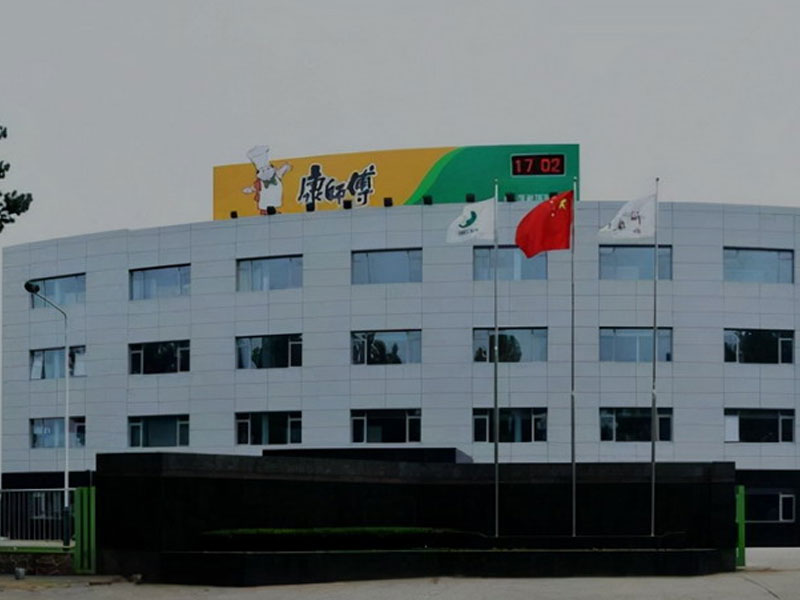
Tear open a packet of instant noodles and there are usually three things inside: the powder sachet, the paste sachet and the dried vegetables. The powder sachet looks the least significant and is the hardest to make — it has to sit in a high-salt, low-moisture environment, stay in the bag with the noodle block for half a year, and still release its aroma the instant the bag is opened and hot water added. This is where savoury flavours are difficult: it is not enough to make them smell good; they have to taste the same after six months under the triple pressure of high salt, high temperature and long storage. Master Kong started its first instant noodle plant in Tianjin in 1992; it is the core brand of the Ting Hsin International Group, listed in Hong Kong in 1996, and thirty-four years on it is still going. The product line runs from instant noodles such as braised beef and pickled cabbage beef to drinks such as iced black tea, green tea, jasmine tea, mineral water and milk tea, and on to rice crackers, biscuits and cakes. After all these years, the name Master Kong is known to almost everyone in China — what it has always made is the everyday life of ordinary people.
That word "everyday", placed on a supplier, means three things: large volume, stability, and low price. Several tonnes of material a day, every batch the same; prices pressed thin, with no room for fluctuation; and if supply breaks, production lines across the country wait. Delivering those three at once is not luck; it is the household accumulated over thirty years: how much land at the cultivation end, which varieties picked when; how many lines at the extraction end and how the parameters are tuned; how many samples kept at the testing end and what problems have occurred. These things look trivial; put together they are those four words: "every batch the same". What we supply to Master Kong is the natural aroma materials for the instant noodle seasoning and ready-to-drink tea lines. There is no clever trick in this trade, only clumsy work.
What the two companies have in common is that both have got into the everyday life of ordinary people. Master Kong's instant noodles and iced black tea appear on countless dinner tables and work desks; the materials we extract end up inside those same things. Making tastes that the mass market can afford sounds less glamorous than making high-end products, but the requirements are actually harsher: the price has to be held down, the quality cannot loosen, and the volume cannot break. Nobody complains if a high-end flavouring costs more; with a packet of noodles at two and a half yuan, if the taste slips a little, people switch brands immediately. Thirty years in this trade, we have always been this kind of people — not choosing jobs, just doing ordinary things well. Master Kong is the same, which is why sitting down to talk business is so easy.
The cooperation began with a product upgrade. The client wanted to make the flavour of a product that had sold for many years a little more "real" — not to change the formula, but to replace the aroma in it with what it should have been all along. The real hurdle came after: the taste of an old product cannot change. Consumers are used to that taste, and if the material is changed, even by a little, old customers can taste it. We ran dozens of comparison groups back and forth, laying the aroma profiles of the old and new material side by side item by item, and only when the two curves almost overlapped did we dare say the change could be made. The hardest part in those months was not the technology but the measure — how much change counts as "better", how much counts as "changed"; that line in between has to be found by tasting again and again.
Talking about technology is clearest by the time the product spends on the shelf. In the first month or two, what is needed is a correct aroma that comes out strongly, which rests on aroma concentration enriching the actives — small dosage, full performance. In the third and fourth months, the test is oxidation resistance: in a high-salt environment the aroma easily turns dull and rancid, so molecular distillation presses down the easily oxidised components and unstable impurities, making the material itself "cleaner"; combined with controlled release, so the aroma comes out more slowly and does not burst in the first two months and leave the next four empty. In the fifth and sixth months, the test is that it neither picks up nor changes odour — the material has to live with the noodle block, the paste sachet and the packaging for half a year, which rests on supercritical fluid extraction cleaning up residues and off-notes so that fewer tails are left at the process level. These three roads are not walked separately; they are designed in together from the start.
On supply, Master Kong has production bases across the country, so we schedule and ship separately by base, and every plant receives the same specification with none favoured over another; when a promotional season brings a sudden increase, we raise output with it rather than using "the plan is full" as a shield. On service, what the client wants is solid ground: we run accelerated shelf-life testing for them and give the data in advance, so the client is not the one taking the risk; supplier audits and ESG questionnaires are passed in one round with nothing left hanging. When the client's people come to the plant, what they look at is never the sample cabinet — it is the capacity schedule, the traceability records and the warehouse.
For the years ahead, what the two sides need to do together is clear: take the flavour of the old products inch by inch towards "real", make the natural character of new products stand up more firmly, and press both cost and carbon down together. Making tastes that the mass market can afford is its own kind of skill — Master Kong has done it for thirty-four years, and we would like to keep doing it too.
This article was published on 2026-09-14, and last updated on 2026-09-21. The article will be continuously updated.