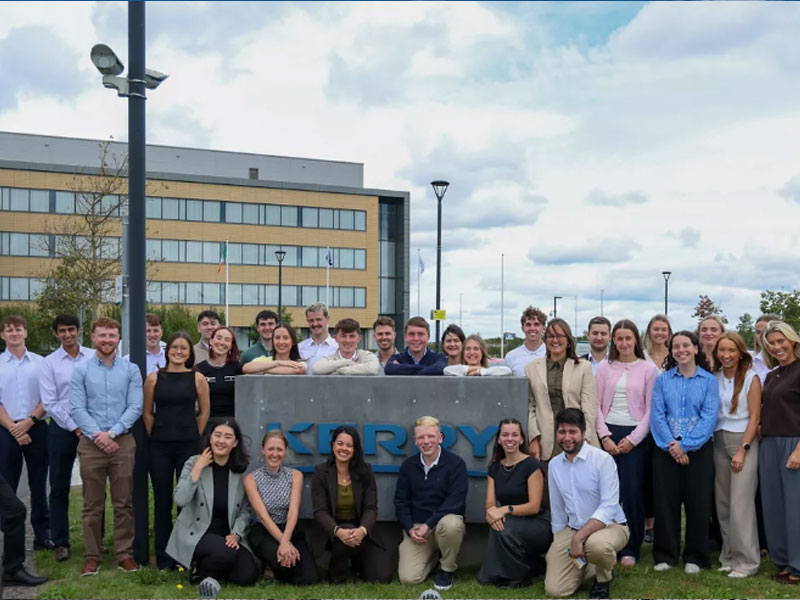
Kerry works to a fixed order: find out first what taste the consumer wants, and work backwards to how the formula should be built. Most flavour companies develop once the requirement arrives; Kerry digs the requirement out first. It does that through food innovation centres spread across the world and a whole method of consumer insight — blind tests, descriptive sensory analysis, consumption trend tracking — getting "what people will want to drink next year" right to seventy or eighty percent before deciding what raw materials will deliver it. That method makes Kerry distinctive in this industry. Kerry began in 1972 in Listowel, County Kerry, Ireland, originally a regional dairy business, and after the 1980s internationalised and diversified, building its taste and nutrition business through acquisition. Headquarters is still in County Kerry; it has close to 22,000 employees, annual revenue of around eight billion euros, production sites and R&D centres in more than thirty countries, and products sold into more than 150 countries and regions.
On the business side there is only one main line — taste and nutrition — under which sit four parts: Taste, covering flavours for beverages, dairy, confectionery and bakery, savoury and health foods; Ingredients, producing functional ingredients, texture solutions, enzymes and fermentation-derived products; Nutrition, working on plant-based, sports nutrition and functional food ingredients; and Foodservice, serving chain restaurants and food service companies. There is also a dairy business in Ireland itself. What we take on is the most upstream link: the natural materials that form the flavour skeleton inside a flavour formula, and the plant ingredients in functional foods whose origin can be explained. Kerry looks at suppliers in a particular way — not only at the numbers on the test report, but with one more question: "where did this number come from". At Kerry, natural is not a label; it is something that has to come with an account of the process — how it was extracted, at what temperature, whether any chemical route was used. We can take that line of questioning, because it is what we do anyway.
The understanding between the two companies comes down to this: we are both working for the same person — the one who takes that sip, that bite, at the end. Kerry's insight teams spend great effort studying that person, and our workshop spends great effort being worthy of that person: the same drink bought this year and bought next year cannot have a step between them; if the ingredient list says natural, then it really has to come from nature. The raw material link is the furthest from the consumer and the easiest place to wreck the finished product — let the aroma of one batch drift a little, and on the shelf it becomes "the taste seems to have changed". Kerry's application centres understand formulas, our workshop understands plants, and neither half can be missing. Both sides take the same attitude towards it: no fudging.
Kerry spent two years looking for a stable source worldwide and ended up in Guangxi, and that is how the cooperation began. The real hurdle was how to wear the "natural" hat: the EU definition of a natural flavouring turns on the process, and if any one step uses an auxiliary aid, the whole batch cannot be counted as natural. One of our steps at the time sat exactly on that line — every test figure passed, but the label could not be used. Over that half year we replaced that step entirely with a purely physical route — supercritical fluid extraction, low temperature throughout, no solvent entering the process — accepting lower yield and higher cost so that the word "natural" would stand up. After the change we ran stability and application testing once more from the beginning, and only then did we really get into Kerry's system.
Later Kerry arranged a round of blind testing, putting the material of several suppliers side by side, and it was from that round that we saw clearly which items we are strong in. The first round compared aroma fidelity: the material was added to a base system and the panel scored it against a reference made from fresh raw material, and what carried us was Living-Fragrance physical extraction, moving the plant's original aroma structure across intact by physical means with no foreign modification. The second compared retention after heating: the same material was evaluated once more after a heating pass, and what carried us was molecular distillation combined with controlled release, letting the aroma come out more slowly and last longer. The third compared clarity and dissolution, carried by pushing refining depth one notch forward and then using aroma concentration to enrich the actives — less added, and the system stays clear. The fourth compared batch consistency: three batches sent consecutively, then another a month later, carried by dynamic multi-stage counter-current extraction pulling the actives out cleanly, plus a record kept of every parameter, so the step between batches was pressed down. After four rounds, Kerry's application centres took our specification as the default benchmark when developing new products.
On supply we follow Kerry's rhythm as well: during trial production Kerry needs material in small batches and high frequency, and that is how we schedule it, without treating it as a nuisance; the varieties for Kerry carry dedicated batch numbers, and the line runs from raw material to finished product as one, so a problem can be traced to the bottom in one go. Service is more substantial still: whatever number of grams the innovation centre asks for, we give that many, with no minimum order, and the packing follows laboratory habits; test methods are aligned with Kerry's internal methods before specifications are discussed, which saves every argument about whose figures count. The people move around too — Kerry's R&D spent a week in our workshop watching how material comes out of the tank, and our people went to Kerry's innovation centre to see how a drink gets evaluated.
For the years ahead, what the two sides need to do together is clear: take plant-based and functional foods deeper, raise the speed of raw material introduction a little further during new product development, and make the evidence chain behind the word "natural" more complete. Kerry knows what consumers want; we know what the plant can give. Put those two together and the sip on the shelf turns out right.
This article was published on 2026-09-14, and last updated on 2026-09-21. The article will be continuously updated.