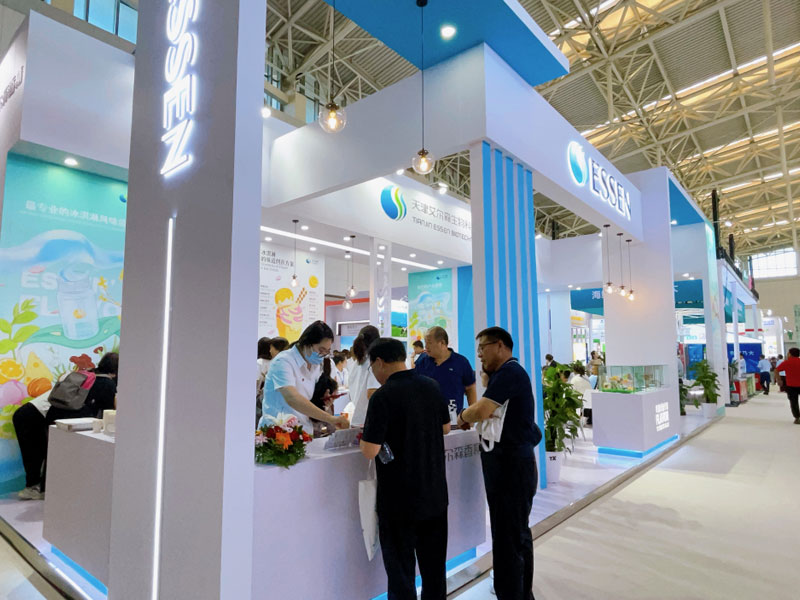
Ice cream is one of the hardest places to make aroma. The same flavour compound smells just right at room temperature and is almost undetectable once frozen to minus eighteen — not because the aroma has escaped, but because the human nose's perception of odour drops sharply at low temperature and the aroma molecules cannot volatilise, so the scent stays "shut in". Anyone making flavours for frozen foods therefore has to think one layer further than someone making an ambient product: it is not a question of how much to add, but whether it can still come out at low temperature. That is the work Tianjin ESSEN does. The company was founded in Tianjin in 2005, wholly US-owned, working exclusively in food flavours, sitting in the Tianjin New Technology Industrial Park. The team is small, some eighty people, yet it holds thirty-six patents. The products fall into six categories — milk, egg, vanilla, fruit, sugar and chocolate — used in ice cream, dairy, confectionery, jelly and bakery. R&D is structured in three parts: a flavour R&D centre, an application service centre, and a fundamental research centre — the last one being something many peers are reluctant to set up, because it does not produce products directly; it studies where the raw material of aroma and flavour comes from.
ESSEN states it clearly: it wants to "strive to obtain the materials and resources of aroma and flavour from natural foods". We find that sentence familiar, because it is what we have been doing for thirty years — aroma has to come from the real thing. Vanilla should taste like the vanilla pod; egg should smell of egg itself; and the aroma of milk is not assembled from a few molecules. Chemical routes can produce a taste that is "like", but between "like" and "is" there is a layer: the former is gone after one sniff, the latter stays in the mouth a while. What we do in plant extraction in Guangxi rests on this clumsy method — real material in, real material out, nothing but physical steps in between, no foreign modification. ESSEN is the same: it would rather look for material in nature than take a shortcut easily. On this point the two sides walk the same road.
The cooperation began with a vanilla ice cream flavour. What the client wanted was not "vanilla flavour" but "the taste you get from real vanilla pods" — anyone who has eaten both knows the difference. The real hurdle followed soon after: the flavour was made, evaluated well at room temperature, and then failed once frozen — at the moment the lid opened there was almost no aroma, and it only came out slowly in the mouth, yet ice cream stays in the mouth only briefly, so by the time the aroma arrives it has already been swallowed. Adding more does not solve this, because at room temperature a higher dose smells aggressive. Our answer was to adjust the composition: raise the proportion of those components that still volatilise easily at low temperature and have a low threshold, using aroma concentration to enrich the actives and then molecular distillation to cut by boiling range and take the segment that is "willing to come out" in the cold. After the change, that flavour performed in the frozen state almost the same as at room temperature.
The material for ESSEN solves three problems in the end. The first is release at low temperature — the point just described, resting on concentration plus fractionation, so the aroma comes out even when cold. The second is masking — dairy has its raw milk note, egg has its eggy note, sugar in quantity turns cloying, and these base notes have to be held down. That rests on targeted composition: using natural material to press down the shortcomings of natural material rather than covering them forcibly with a masking agent. The third is cost — margins in food flavours are thin, and ten cents more on the material is a large sum over a client's year. That rests on extracting the actives cleanly: dynamic multi-stage counter-current extraction, high yield and short time under heat, so more comes out of the same raw material; plus concentration, so the client adds less and the effect remains. Two further basic disciplines run through the whole process: supercritical fluid extraction, low temperature throughout with no solvent entering the process, so the natural character stands up; and Living-Fragrance physical extraction, moving the plant's original aroma structure across intact by physical means, so fidelity is guaranteed.
There is craft in how we work together as well. The client moves in three stages — bench trial, pilot, mass production — so we supply different pack sizes for the three stages rather than making them open a large drum for one kilo. For regularly used varieties we hold safety stock, so a sudden request can still ship the same day. On test data, we measure how the material behaves at low temperature before giving it to the client: aroma release curves at 4°C and at minus 18°C, and compatibility with common bases, all attached, so the client does not have to find it out again. When the client makes a proposal downstream, we supply application samples so the other side can taste the effect on the spot. ESSEN's application engineers also often take our material along to downstream demonstrations, and there is a conclusion right after the demonstration.
For the years ahead, what the two sides need to do together is clear: raise the low-temperature performance of the frozen food line another notch, widen the range of natural raw material varieties, and press cost down a little further without touching the aroma. What goes into the mouth cannot be fooled — whether it is good, the tongue knows on the first bite. ESSEN looks after making that taste seem real; we look after making it real to begin with.
This article was published on 2026-09-14, and last updated on 2026-09-21. The article will be continuously updated.