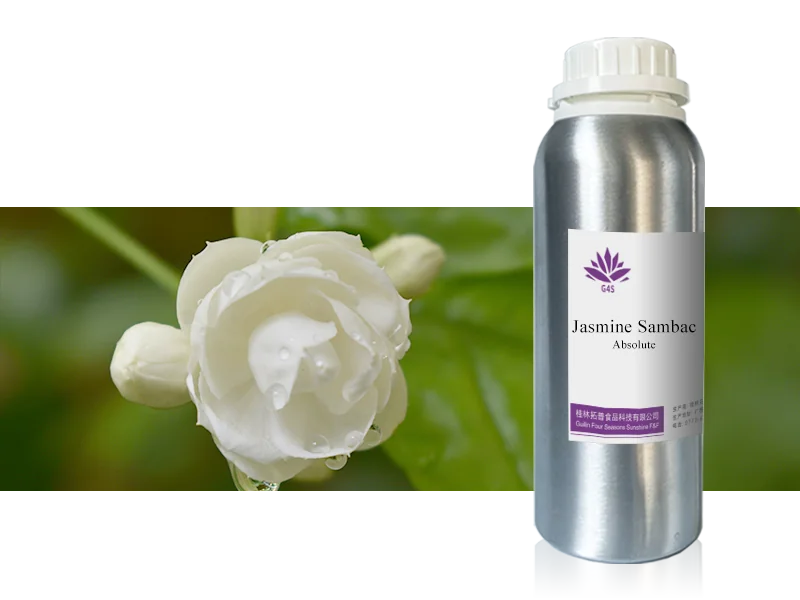

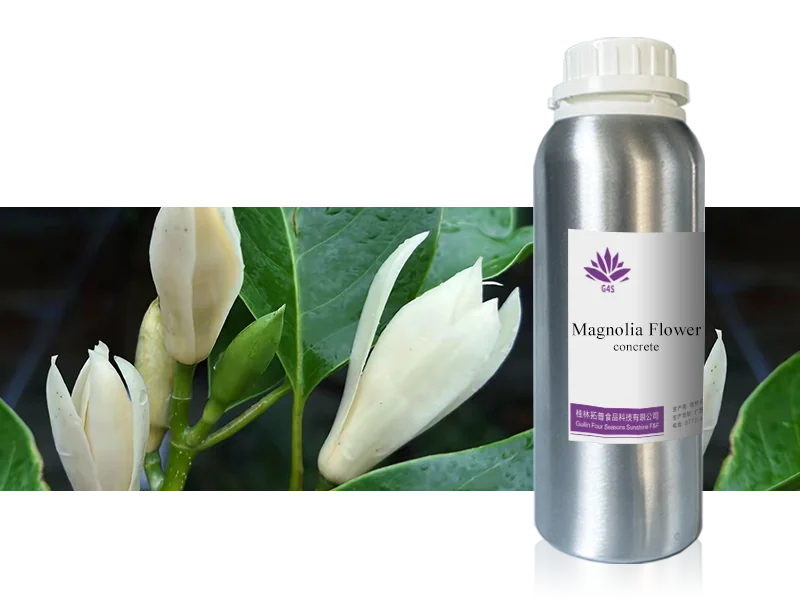
How US Manufacturer Buyers Convert Three Quote Formats into One Comparable Per-Kilogram Cost Table for Michelia Alba Concrete?
Build a usable per-kilogram cost table by first separating solvent-extracted concrete from essential oil, leaf oil and absolute, then converting every quote to a kg basis and flagging every value that is not public as "supplied on inquiry" instead of estimating it.
If you are a buyer at a US flavor & fragrance, fine-perfume or personal-care manufacturer sourcing Michelia Alba Concrete, you have probably seen three incompatible numbers on your desk: an inquiry-only quote for the reddish-brown waxy concrete, a public "white champaca essential oil" band of ¥900–4200/kg, and a Michelia leaf-oil micro-sample at USD 0.1/g. None of them can be placed side by side until you normalize form, plant part and currency into one comparable per-kilogram table. This guide gives you that table, the first-round 12-question inquiry, a three-supplier scorecard, and the compliance evidence fields that stop a low headline price from rebounding at receiving. Every price, marker and regulatory status below is tagged with its source and the line between published figures and quotes that must be requested — nothing is invented.
1. Avoid the Three-Format Mix-Up Before You Compare Quotes
Result you get: in about five minutes you can decide whether three quotes describe the same physical substance, and write the reason for "not comparable" into table fields rather than relying on a supplier's verbal assurance.
The four-field test that separates concrete, essential oil, leaf oil and absolute
- Check four fields on every quote: botanical name, plant part, extraction method and physical form. If any one differs, the quote goes into the "not directly comparable" zone.
- Michelia Alba Concrete should read Michelia × alba DC. (verify the standardized name with the supplier), Flower, Solvent Extraction, and a reddish-brown to dark-brown waxy concrete.
- The public "white champaca essential oil" quotes mostly describe a steam-distilled, pale-yellow transparent liquid — an essential-oil format, not this product.
- The Michelia leaf-oil micro-sample at USD 0.1/g converts mathematically to USD 100/kg, but it is still a leaf-oil micro-sample, not a concrete price per kilogram.
- Michelia Flower Absolute is the dewaxed downstream product of concrete; a liquid absolute format does not belong in the same price column as a waxy concrete.
Boundary table: three quote formats that cannot be compared directly
| Original quote format | Public number / source tag | Form and constituent profile | Directly usable as concrete price? | Buyer action |
|---|---|---|---|---|
| Michelia Alba Concrete | No public bulk price; inquiry-based; exact price available only on inquiry | Reddish-brown to dark-brown waxy concrete; solvent extraction; benzyl alcohol / benzyl acetate / linalool-type florals | No — must inquire first | Request 1 g/5 g sample price, 100 g/1 kg/25 kg tiers, COA and GC-MS/HPLC |
| White champaca essential oil | ¥900–4200/kg; public channels / inquiry-based; verify with the supplier | Essential-oil format; publicly described as steam-distilled pale-yellow liquid | No | Use only as an essential-oil price anchor, never as a substitute for the concrete quote |
| Michelia leaf-oil micro-sample | USD 0.1/g; public channel, verify the figure with the supplier; equals USD 100/kg | Leaf-oil micro-sample; different plant part and form | No | Use only as a micro-sample market-band reference |
| Michelia Flower Absolute | Same manufacturer associated product; same CAS but a liquid absolute format; verify with the supplier | Concrete → absolute; different physical form | No | Link for form comparison; do not place in the same price column |
Tool/template entry: the "three-format determination table," the "first-round 12-question email template," and the "supplier quote-format declaration field."
Seen & Trusted evidence slots: [product-page specification screenshot] [GC-MS/HPLC fingerprint example slot] [CAS-form correspondence letter placeholder]. Do not use "same CAS" as a substitute for a form explanation.
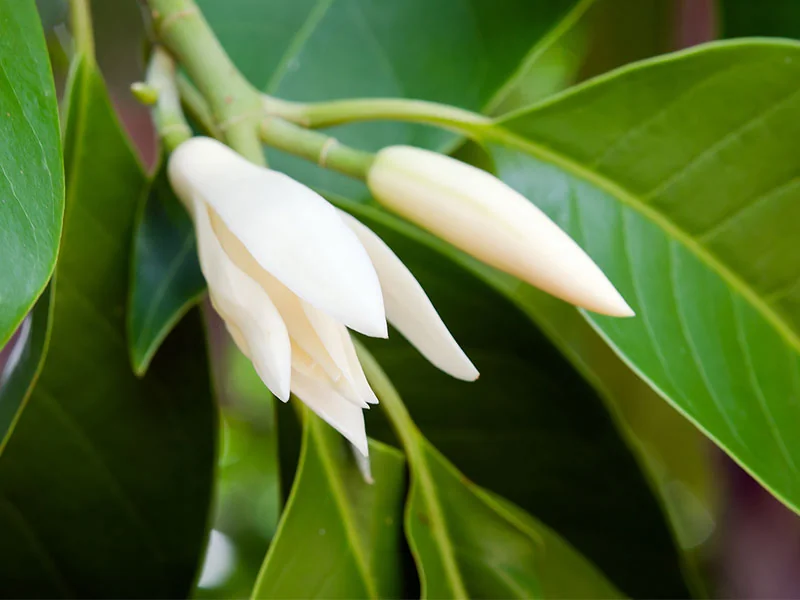
2. Lock the Comparison Object with Species, Part and CAS/EC/INCI
Result you get: you pull Michelia Alba Concrete out of confusing CAS numbers and trade names and produce one identity statement that technical, purchasing and compliance can all sign.
The identity conclusion this article compares: solvent-extracted concrete only
- Product object: Michelia Alba Concrete, a solvent-extracted concrete.
- Plant part: Flower only; no leaf, stem or synthetic substitute, with the boundary declaration confirmed in writing by the supplier.
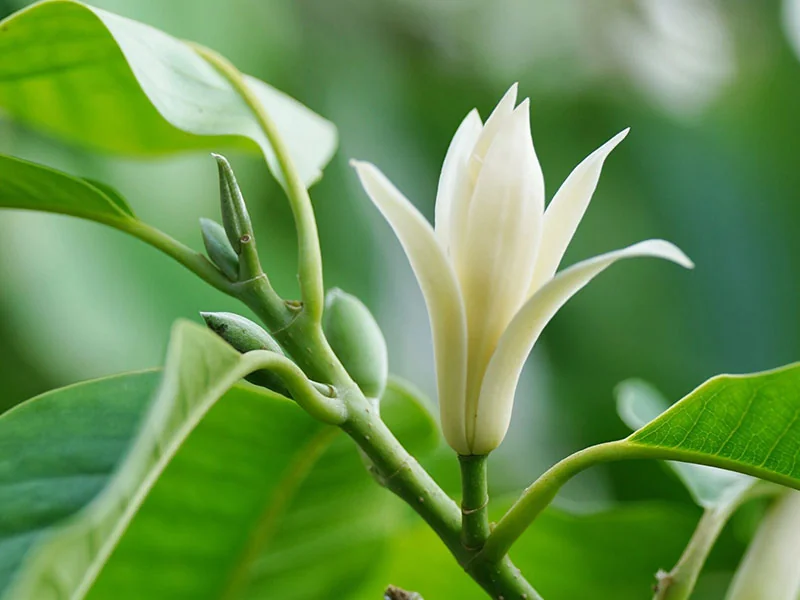
- Appearance and aroma: reddish-brown to dark-brown waxy paste with a creamy, intensely sweet white-champaca floral odor.
- Acid value ≤50; publicly stated shelf life 36 months; actual batch values per COA.
- Explicit exclusions: white champaca essential oil, Michelia leaf oil, Michelia Flower Absolute and synthetic white-floral compounds.
Core EAV table: write entity, attribute and value into the inquiry attachment
| Entity | Attribute | Value | How the buyer uses it |
|---|---|---|---|
| Michelia Alba Concrete | Botanical Name | Michelia × alba DC.; obtain the standardized name and botanical voucher from the supplier | Put in the inquiry to prevent confusion with yellow champaca Magnolia champaca |
| Michelia Alba Concrete | Plant Part | Flower | Excludes leaf-oil quotes |
| Michelia Alba Concrete | Extraction Method | Solvent Extraction | Excludes steam-distilled essential-oil quotes |
| Michelia Alba Concrete | Physical Form | Reddish-brown to dark-brown concrete | Excludes liquid absolute and essential oil |
| Michelia Alba Concrete | CAS | 92457-18-6; correspondence to this physical form to be explained in writing by the supplier | Not a standalone basis for price comparison |
| Michelia Alba Concrete | EC/EINECS | 296-299-2; confirm against the batch documents | Checked together with the CAS-form statement |
| Michelia Alba Concrete | INCI | Michelia Alba Flower Extract; confirm for this batch | Used for label and formula-file checks |
| Michelia Alba Concrete | Markers | benzyl alcohol, benzyl acetate, linalool-type florals | Verified with GC-MS/HPLC fingerprint |
| Michelia Alba Concrete | Commercial Model | Inquiry-based, no public bulk price | Requires three or more inquiries to form a price baseline |
CAS-form correspondence checklist: why the same CAS still cannot be compared
- Public sources attach CAS 92457-18-6 to white champaca oil, absolute, extract and multiple other forms, many described as pale-yellow liquid.
- This product is a reddish-brown waxy concrete; the supplier must state in writing how the CAS maps to this form and let the actual sample GC-MS/HPLC fingerprint govern.
- Keep a "CAS-form statement complete?" column in your table; a supplier without a complete statement does not enter the final shortlist.
Quick win: add one line to the inquiry — "State in writing how CAS 92457-18-6 corresponds to this reddish-brown waxy concrete, and confirm EC 296-299-2 and INCI Michelia Alba Flower Extract for this batch." Treat a blank answer as a missing document, not as a passes-by-default item.
Tool/template entry: the "EAV identity checklist," the "CAS-form correspondence letter template," and the "species/part/form declaration field."
Seen & Trusted evidence slots: [botanical voucher placeholder] [COA batch number and date placeholder] [GC-MS/HPLC fingerprint placeholder] [supplier CAS-form letter placeholder].
3. Build One Per-Kilogram Comparable Cost Table
Result you get: a one-page cost sheet you can send to finance and management, where every missing item is marked "supplied on request" and no estimate substitutes for a real quote.
The per-kilogram formula: convert to kg first, then add one common set of cost variables
- Concrete comparable cost = concrete quote per kg + documentation/testing allocation + logistics/duty/hazardous-material handling allocation + yield or loss adjustment + capital/FX cost + risk reserve − quantifiable discounts.
- Essential oil to kg: ¥900–4200/kg is already a per-kilogram figure; source is public channels / inquiry-based; verify with the supplier.
- Leaf oil to kg: USD 0.1/g × 1000 = USD 100/kg — a mathematical conversion only, not a concrete price.
- Concrete if quoted per gram: quote/g × 1000 = quote/kg; if no bulk price exists, mark it "quote on request."
- Until FX, tax, Incoterms, duty and any Section 301 applicability are confirmed, do not collapse different currencies into a single total.
Normalization field table: keep non-comparable items visibly in the sheet
| Field | Michelia Alba Concrete | White champaca essential oil | Michelia leaf-oil micro-sample | Recording discipline |
|---|---|---|---|---|
| Original quote | Inquiry-based; request the quote | ¥900–4200/kg, public channels / inquiry-based; verify with the supplier | USD 0.1/g, public channel, supplied on request | Record the source verbatim, do not rewrite it |
| kg conversion | quote/kg or quote/g × 1000 | Already a per-kg quote | USD 0.1 × 1000 = USD 100/kg | Math conversion only, no equivalence claim |
| Form | Reddish-brown waxy concrete | Essential-oil liquid format | Leaf-oil micro-sample format | Different forms go in the notes column |
| Plant part | Flower | Mostly flower-oil format | Leaf | Different parts must not be merged |
| GC-MS/HPLC | Must request | Can request, but a different profile | Can request, but a different profile | Different fingerprints must not be pooled |
| Sample cost | 1 g/5 g price on request | On request | USD 0.1/g is the public anchor | Sample price is not a bulk price |
| Tiered quote | 100 g/1 kg/25 kg on request | On request | On request | No tier price means "request a quote" |
| Testing/documents | COA, MSDS, GC-MS/HPLC, allergens, solvent residue on request | On request | On request | Do not assign a cost estimate to documents |
| Landed variables | Incoterms, HS, Section 301, hazardous transport on request | On request | On request | Items without a figure are not converted into numbers |
| Price lock | 90-day lock to be negotiated | On request | On request | State start/end dates and covered volumes |
| Risk note | Not directly comparable with essential oil or leaf oil | Essential-oil anchor only | Micro-sample anchor only | Keep in the table, do not delete |
Fill-in example: structure only, no invented concrete price
| Supplier / format | Original quote | kg result | Form consistent? | Document pack complete? | MOQ / tiers | 7-day sample | 90-day lock | Comparable-cost conclusion |
|---|---|---|---|---|---|---|---|---|
| Supplier A / concrete | Supplier to provide | Supplier to provide | On request | On request | On request | On request | On request | Not priceable — enter inquiry |
| Supplier B / essential oil | ¥900–4200/kg, public channels / inquiry-based; verify with the supplier | ¥900–4200/kg | No — essential-oil format | On request | On request | On request | On request | Essential-oil anchor only |
| Supplier C / leaf-oil sample | USD 0.1/g, public channel, supplied on request | USD 100/kg | No — leaf-oil format | On request | On request | On request | On request | Micro-sample anchor only |
Tool/template entry: the "per-kilogram comparable cost table field guide," the "kg conversion formula card," and the "missing-value filling rule."
Seen & Trusted evidence slots: [three original quote screenshots] [currency and Incoterms fields] [supplier document-pack reference numbers] [finance review sign-off].

4. The First-Round 12 Questions That Turn Inquiry-Only Quotes into Numbers
Result you get: one email that returns the minimum dataset needed for the comparison table, reduces back-and-forth, and fronts-loads the 7-day sample and 90-day lock into round one.
Twelve first-round questions: ask price, identity, documents and delivery together
- Do you supply Michelia × alba DC. flower solvent-extracted reddish-brown waxy concrete, and can you provide a botanical voucher?
- Can you provide a letter explaining how CAS 92457-18-6 corresponds to this concrete form?
- Are EC/EINECS 296-299-2 and INCI Michelia Alba Flower Extract consistent with this batch?
- What are the 1 g/5 g sample prices, and do they include GC-MS/HPLC, COA, MSDS, allergen and IFRA documents?
- Can samples ship within 7 days, and what are the ship date and arrival date?
- What are the 100 g / 1 kg / 25 kg tier prices, and what are the quote currency and Incoterms?
- What is the MOQ, and can batches ship against a 2–4 week safety-stock replenishment schedule?
- Can you offer a 90-day price lock, and which volume bands and order types does it cover?
- Can you provide per-batch COA, GC-MS/HPLC fingerprint and benzyl alcohol / benzyl acetate / linalool-type marker data?
- Are solvent residue GB 5009.262, contaminants GB 5009, heavy metals ChP/USP and pesticide residue tested per batch, and can an expanded multi-residue scan be appended to the COA on request?
- Are the IFRA 51st Amendment compliance certificate, benzyl alcohol/linalool allergen quantification and a non-food use-boundary statement complete?
- Can you support post-harvest-window replenishment rhythm, combustible-concrete shipping documents, and Form E / CO / dangerous-goods declarations?
Three-or-more-supplier rhythm: a 7-day sample builds a price baseline, not pressure
- Send the same inquiry template to at least three suppliers on the same day and require same-format responses.
- Within 7 days, collect: samples, original quotes, document-pack reference numbers, tiered prices and lock terms.
- In week two, complete form determination, EAV checks and COA/GC-MS/HPLC screening.
- In weeks 2–6, complete internal aroma blind evaluation and application testing; the exact cycle follows the customer's own validation process.
- Suppliers with expired quotes, missing documents or mixed formats do not enter the final per-kilogram cost table.
Tiered quotes and a 90-day lock: separate "cheap now" from "usable later"
- Tiered quotes must state the quantity band: 1 g/5 g, 100 g, 1 kg, 25 kg; ask whether price adjusts by batch, harvest season or FX.
- A 90-day lock must state start/end dates, covered quantities, whether freight and duty are included, and whether it applies to follow-on orders.
- MOQ and replenishment must align with a 2–4 week safety stock; a high MOQ or an unexplained replenishment rhythm earns a risk note in the cost table.
Quick win: put questions 4, 6, 8 and 11 at the top of the email. If a supplier cannot answer sample price, tiered price with currency/Incoterms, a written lock and a non-food use statement, you have saved yourself a full comparison cycle.
Tool/template entry: the "first-round 12-question email template," the "three-supplier quote return sheet," the "7-day sample tracker," and the "90-day lock term draft."
Seen & Trusted evidence slots: [inquiry email send log] [courier number and sample batch number] [original quote screenshots] [lock-term reply screenshots].
5. Turn GC-MS/HPLC and Compliance into Cost Line Items
Result you get: testing, compliance and use-boundary items move from "attachments" into comparison fields, so a cheap but document-light quote is automatically downgraded.
The product-level evidence pack: each batch COA must answer five buyer questions
- What species, what plant part, what form? Obtain the standardized species name and botanical voucher.
- Does the batch match the white-floral markers? Look at the GC-MS/HPLC fingerprint for benzyl alcohol, benzyl acetate and linalool-type florals; read the measured values from the batch COA.
- Is the batch safe for the intended application? Check solvent residue GB 5009.262, contaminants GB 5009, heavy metals ChP/USP, pesticide residue and allergen quantification; read the measured values from the batch COA.
- Is the batch traceable? Check batch number, manufacture date, retained-sample reference and the botanical name/part/origin/date declaration; retained sample ≥24 months and a 3-year reference standard are public commitments, verify each batch against the retained sample.
- Can it enter the formula? Check English MSDS, TDS, IFRA, allergen statement and use-boundary statement; any missing item loses points in the scorecard.
IFRA, allergens and the non-food boundary: do not write compliance uncertainty as a "low-cost advantage"
- Benzyl alcohol (CAS 100-51-6), linalool and the EU 1223/2009 allergen declaration as amended by (EU) 2023/1545 are relevant; thresholds and scope must be re-checked against the finished-product category.
- The IFRA 51st Amendment compliance certificate should be part of the quote document pack; the 52nd Amendment is under consultation and must not be written as an in-force conclusion.
- Fine fragrance, cosmetics, candles, herbal fragrance and tobacco flavoring follow different review paths; tobacco use requires separate review under the FDA Tobacco Control Act.
- If a product page lists a food & beverage field, in the absence of FEMA GRAS or FDA food-substance permission evidence it must be limited in writing to non-food / fragrance use, with no food or beverage claim made to US customers.
- A supplier who evades the use boundary or extrapolates a Chinese food permit into US compliance is a rejection warning.
Seen & Trusted evidence tiers: separate company-level backing from single-product evidence
| Evidence tier | What may be written | What may not be written |
|---|---|---|
| Company level | G4S is a source factory; 25,000 m² production base; 137 IP assets; 30+ years of plant-extraction experience; IFEAT member; clients include Givaudan, DSM-Firmenich and Symrise at company level | Do not write that these clients purchase this specific Michelia Alba Concrete |
| Product level | Per-batch COA, GC-MS/HPLC, benzyl alcohol/benzyl acetate/linalool-type markers, retained-sample and reference-standard system, English MSDS | Do not fabricate measured percentages, test values or batch numbers |
| Quote level | Original quote, currency, Incoterms, tier prices, 90-day lock, document-pack reference numbers | Do not write public essential-oil/leaf-oil prices as concrete bulk prices |
| Delivery level | 7-day sample records, post-harvest replenishment notes, hazardous-transport documents, Form E/CO issuance status | Do not promise unconfirmed lead times, tax rates or transport classifications |
Tool/template entry: the "8-item document-pack checklist," the "allergen/IFRA checklist," the "non-food use statement template," and the "Seen & Trusted evidence slot list."
Seen & Trusted evidence slots: [COA sample] [GC-MS/HPLC chromatogram placeholder] [IFRA certificate placeholder] [non-food statement template].
6. Fold MOQ, Lead Time, Replenishment and a 90-Day Lock into Cost
Result you get: time, inventory, logistics and price locks become comparable fields so that a bare headline price cannot hide a supply-break risk.
MOQ and 2–4 week safety stock: align purchase lots with production scheduling
- The buyer sets MOQ against a 2–4 week safety stock; the actual MOQ is supplied on request.
- 100 g/1 kg suits sample-to-pilot transition; 25 kg suits a framework or small trial production run; higher volumes require a separate inquiry.
- Replenishment rhythm must be read together with the white-champaca harvest window, batch consistency and the retained-sample system.
- If MOQ exceeds current demand, the cost table needs a separate "inventory occupation" note; do not disguise excess stock as a low price.
Landed-cost variables: check Incoterms, HS, Section 301 and combustible-concrete transport item by item
- Quotes must state Incoterms, load/discharge port, currency and payment terms; anything unstated is "supplied on request."
- HS candidate 3301.29 covering concretes and absolutes; the specific subheading and duty rate must be determined by the customs broker by form and use.
- Chinese origin may attract Section 301; De Minimis and rate changes must be re-checked against current rules — this article gives no conclusion.
- Public sources put West Coast LA/Long Beach transit at roughly 15–18 days; confirm the actual transit and clearance time with the forwarder.
- Handle Michelia Alba Concrete as a combustible organic extract (waxy concrete), away from open flame and heat; SDS, transport classification and packing requirements are supplied on request and carrier.
90-day lock terms: write FX, batches and follow-on orders explicitly
- A 90-day lock is not a verbal promise; state the covered product, quantity, currency, start/end dates and whether freight and duty are included.
- Net 30 or 30% deposit + 70% against copy of bill of lading are industry practices to be agreed in writing — not commitments made in this article.
- If the quote is in CNY and the budget is in USD, record the FX source and date; do not convert to a single currency before confirmation.
- Whether follow-on orders keep the locked price, whether the harvest season triggers repricing, and whether testing fees are charged separately all go into "supplied on request."
Quick win: put a "supply-break risk" note next to any quote whose MOQ exceeds your 2–4 week safety stock or whose replenishment rhythm is undefined; a low unit price with an unplanned stockout is not a low cost.
Tool/template entry: the "MOQ and safety-stock calculator," the "landed-cost variable checklist," the "90-day lock term template," and the "hazardous-transport document list."
Seen & Trusted evidence slots: [customs broker HS confirmation] [SDS/MSDS version] [hazardous-transport declaration] [lock-term signature page placeholder].
7. Use a 100-Point Scorecard to Decide the Order
Result you get: a 100-point scorecard you can hand to management, where the lowest bare price no longer automatically equals the best supplier.
Three-supplier scorecard: price is only part; identity and documents pass first
| Scoring item | Suggested weight | Evidence source | No-score / downgrade condition |
|---|---|---|---|
| Form and identity consistent: concrete, Flower, Solvent Extraction | 20 | EAV table, product page, supplier declaration | Mixed essential-oil / leaf-oil / absolute format |
| Per-kilogram cost transparency | 20 | Original quote, kg conversion, currency and Incoterms | No tier price, no currency, no quote validity |
| 7-day sample and sample batch number | 10 | Courier record, sample label | No sample or no batch number |
| GC-MS/HPLC and markers | 15 | COA, chromatogram, reference-standard statement | No fingerprint or no measured values in the COA |
| IFRA, allergens and non-food boundary | 10 | IFRA certificate, allergen quantification, use statement | Makes food claims without FEMA/FDA evidence |
| MOQ and replenishment rhythm | 10 | MOQ reply, harvest-window replenishment note | Cannot explain replenishment or safety-stock mismatch |
| HS, transport and landed variables | 10 | HS confirmation, SDS, transport declaration | Evades hazardous transport or duty basis |
| 90-day lock and payment flexibility | 5 | Lock terms, payment conditions | Verbal promises only |
| Total | 100 | — | — |
Warning and rejection signals: two or more occurrences pause contract negotiation
- Evades the CAS 92457-18-6 form correspondence and says "same CAS is all the same."
- Uses white champaca essential oil ¥900–4200/kg or leaf oil USD 0.1/g to justify the concrete price.
- Cannot ship samples within 7 days, or samples carry no batch number and no COA.
- Does not provide 100 g/1 kg/25 kg tier prices, or omits currency and Incoterms.
- GC-MS/HPLC, solvent residue, heavy metals, pesticide residue or allergen quantification missing by more than two items.
- No non-food / fragrance-use boundary, or a Chinese permit extrapolated into a US food claim.
- Does not state MOQ, replenishment rhythm or harvest window.
- Vague on the 90-day lock, payment terms or hazardous-transport documents.
Pre-order checklist: keep evidence before signing contract attachments
- Three original quotes archived and tagged "public channels / inquiry-based; verify with the supplier."
- Three quotes converted to a kg basis, with missing values marked "supplied on request."
- Three samples shipped within 7 days, sample batch numbers matched to COAs.
- EAV identity table checked: species, plant part, form and CAS/EC/INCI.
- GC-MS/HPLC and marker documents received, read the measured values from the batch COA.
- IFRA, allergens and non-food boundary confirmed in writing.
- MOQ, replenishment rhythm, 90-day lock and payment terms written into quote notes.
- HS, transport classification, Incoterms and duty variables reviewed by broker/carrier or marked for follow-up.
Quick win: set "form and identity consistent" plus "per-kilogram cost transparency" as a 40-point pass threshold; quotes below 40 do not enter final order discussion.
Tool/template entry: the "100-point supplier scorecard," the "warning-signal checklist" and the "pre-order evidence list."
Seen & Trusted evidence slots: [three scorecard screenshots] [management approval page] [contract clause signature slot] [quote validity screenshot].
8. FAQ: Seven Questions That Trap Buyers on Price Formats
Q1. Leaf oil at USD 0.1/g times 1000 is USD 100/kg — can I use it directly as Michelia Alba Concrete cost?
No. USD 100/kg is only a mathematical kg conversion. Leaf oil and Michelia Alba Concrete differ in species part, extraction method, physical form, constituent profile and application strength, so it cannot be used directly as concrete cost.
Q2. Can white champaca essential oil at ¥900–4200/kg serve as the high-low band for the concrete quote?
No. That band comes from public channels / inquiry-based quotes and is supplied on request, and it is an essential-oil format. It is only a price anchor for natural white-floral raw materials, not a substitute for this product's inquiry price.
Q3. With no public bulk price for the concrete, is three-supplier comparison still meaningful?
Yes. The value is not in fetching a public price but in making three suppliers return quotes on the same EAV, the same kg conversion and the same document-pack requirement, which forms a reviewable inquiry-based baseline.
Q4. Can the CAS 92457-18-6 form correspondence statement be skipped?
No. Public sources show this CAS linked to multiple forms and mostly pale-yellow liquids, which differ from this product's reddish-brown waxy concrete in form and constituent profile. Require a written CAS-form statement and let the GC-MS/HPLC fingerprint govern.
Q5. Can Michelia Alba Concrete be quoted to US customers for food & beverage use?
Only after FEMA GRAS or FDA food-substance permission evidence exists — until then, no food or beverage claim is allowed. This article discusses cost only for non-food / fragrance-use scenarios such as fine perfumery, household fragrance, candles and herbal fragrance.
Q6. Does a 90-day price lock mean the whole year is locked at that price?
No. A 90-day lock must state start/end dates, covered quantities, whether freight and duty are included, and whether follow-on orders are covered. Anything unstated is "supplied on request."
Q7. Higher MOQ means lower unit price — why should the buyer still be careful?
Because MOQ brings inventory occupation, batch concentration, replenishment mismatch and aroma-consistency risk. The per-kilogram cost table must read MOQ together with a 2–4 week safety stock.
Conclusion and Next Steps
Result you get: a buyer moves from reading to inquiry with a copyable one-page cost table and one-page evidence pack that can be sent to three suppliers the same day.
One-page cost table: for purchasing, technical and finance at the same time
- Left column: original numbers and source tags for the three quote formats.
- Middle column: kg conversion, form consistency and document-pack completeness rate.
- Right column: MOQ, 7-day sample, 90-day lock, landed variables and risk notes.
- Bottom line: a conclusion split into "advance to pilot," "re-score after documents" and "pause negotiation."
One-page evidence pack: show management evidence, not verbal judgment
- COA and GC-MS/HPLC fingerprint.
- CAS-form correspondence statement.
- IFRA / allergen / non-food use statement.
- Three original quotes and tiered prices.
- 7-day sample shipping records.
- MOQ, replenishment rhythm and 90-day lock terms.
- HS, transport and Incoterms review status.
CTA and internal-link anchors
- Primary CTA: download the "Michelia Alba Concrete per-kilogram comparable cost table" and fill it back from at least three suppliers.
- Secondary CTA: request 1 g/5 g samples plus the document pack, with a 7-day shipping requirement.
- Internal-link anchors: Michelia Alba Concrete product page, CAS-form correspondence note, GC-MS/HPLC fingerprint page, IFRA/non-food statement, white champaca essential-oil vs leaf-oil form comparison, and tiered-price and MOQ page.
As a source factory, Guilin Four Seasons Sunshine F&F Co., Ltd. (G4S) controls every stage under one roof across a 25,000 m² production base with 137 IP assets and 30+ years of plant-extraction experience, and is an IFEAT member; company-level client names such as Givaudan, DSM-Firmenich and Symrise are public information and are not claims that these clients purchase this specific concrete. For this product, insist on per-batch COA, GC-MS/HPLC fingerprint, allergen quantification, IFRA 51st Amendment certificate and a written non-food use boundary before any price becomes final.
This article was published on 2026-11-25, and last updated on 2026-11-25. The article will be continuously updated.