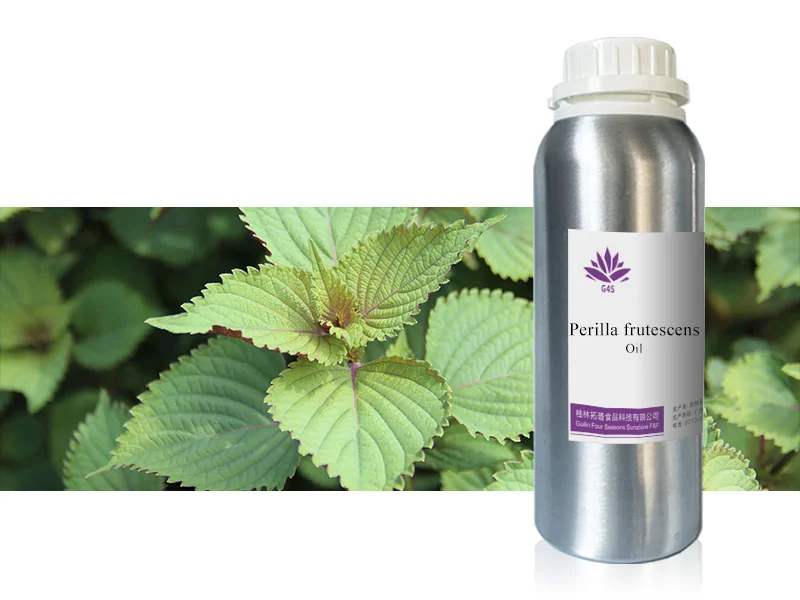
Which production standards and pharmacopoeias does this perilla leaf oil comply with?
The most complete standard system among Chinese herbal oils, covering national pharmacopoeia, a dedicated product specification, food-additive standards, and international norms.
Standards & Compliance
| Standard | Requirement | Application |
|---|---|---|
| Chinese Pharmacopoeia 2025 Ed. I (Perillae Folium) | Volatile oil ≥ 0.40% (ml/g); rosmarinic acid 0.11–1.02% | Botanical raw material standard |
| Red Perilla Leaf Oil Quality Control Specification (Trial) 2025 (SAMR) | Perillaldehyde 18.5–22.7%; rosmarinic acid ≥ 3.2%; Pb ≤ 0.15 mg/kg | Direct product specification for red perilla oil |
| GB 2760-2014 Food Additive Use Standard | Perillaldehyde S0178 (FEMA 3557); perillyl alcohol S0065 (FEMA 2664) | Legal food-flavoring use |
| 2024 CPC draft: Perillaldehyde (plant-derived food additive) | RI 1.498–1.502; rotation -18° to -22° | Upcoming mandatory standard for perillaldehyde |
| ISO 4720:2018 / ISO 210:1999 / ISO 11024-1/2 | Nomenclature / packaging / GC analysis | International essential-oil norms |
| ISO 22000:2018 + EU EC 1831/2003 | Food safety management; feed-additive regulation | International food/feed certification |
- GB/T 26516-2011 (packaging & storage), GB/T 14457.1-2008 (RI), GB/T 14454.2-2008 (density) apply to routine QC
- Heavy metals and pesticide residues follow GB 2762 and GB 2763
- JP18 (Japan) and KP (Korea) also monograph perilla leaves — a key advantage for Japanese and Korean markets
Relate Products
This article was published on 2026-09-07, and last updated on 2026-09-07. The article will be continuously updated.