What are the key aromatic compounds in this peppermint oil?
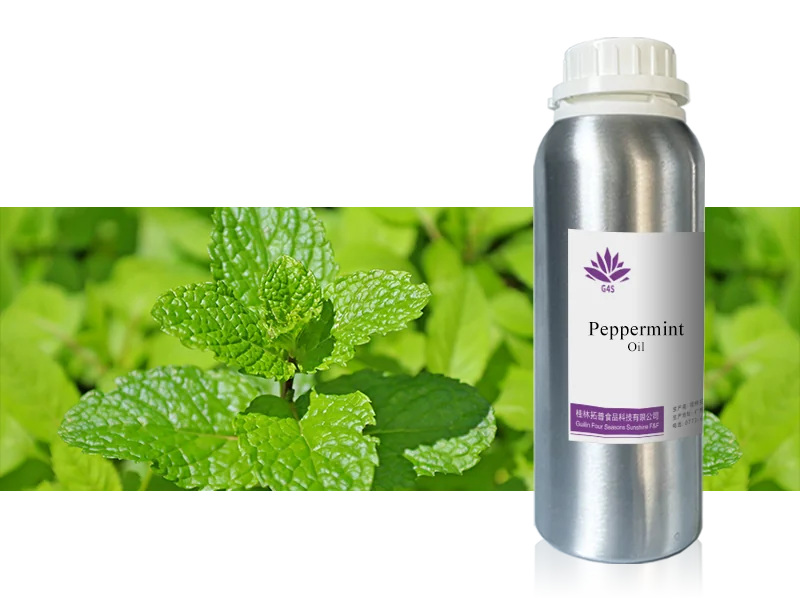
Peppermint oil is a monoterpene-rich oil whose character is set by menthol and its close relatives menthone and menthyl acetate. Menthol is both the odour driver and the source of the cooling sensation, so its level is the first number buyers check on a COA.
Main Components
| Compound | Type | Typical Content | Contribution |
|---|---|---|---|
| Menthol | Monoterpene alcohol | 30-55% (total menthol; free + esters; USP requires total ≥50%) | Cooling, sharp, minty — the signature |
| Menthone | Monoterpene ketone | 15-30% | Woody-herbaceous body |
| Menthyl acetate | Ester | 3-10% | Fruity-sweet roundness |
| Menthofuran | Furanoid monoterpene | 1-10% | Warm, spicy-minty complexity (piperita marker) |
| Neomenthol / isomenthone | Stereoisomers | 2-8% / 1-6% | Balance and natural depth |
| Limonene | Monoterpene | 1-4% | Fresh citrus lift |
| Pulegone | Monoterpene ketone | ≤4% (hard global limit) | Sharp peppery-minty trace; heavily regulated |
The Menthol Story
- Menthol content is the single most important quality indicator: USP requires total menthol ≥50%, while GB 1886.278 and ISO 856 set species-characteristic ranges
- The free-to-ester ratio matters: free menthol gives the strong cooling flash, menthyl acetate softens it
- High menthol usually correlates with higher price — menthol-rich US-type lots trade at a premium
Pulegone — the Regulated Constraint
- Pulegone is naturally present in trace amounts but is the reason peppermint oil carries global restrictions: EU Regulation 1334/2008 limits it to 100 mg/kg in flavoured beverages (final product), and IFRA 51 restricts it to 100% in Category 12 mouth-care use
- Our lots are released with pulegone ≤4% by GC (ISO/GB limit) and typically test far lower, so finished-product compliance is achievable at normal use levels
GC-MS Verification
- Every batch is GC-MS verified with the full component table reported on the COA
- Adulteration watch: added synthetic menthol, dementholated mint oil or eucalyptus oil changes the menthone/menthol and menthofuran ratios — fingerprinting detects these instantly
Relate Products
This article was published on 2026-09-07, and last updated on 2026-09-07. The article will be continuously updated.