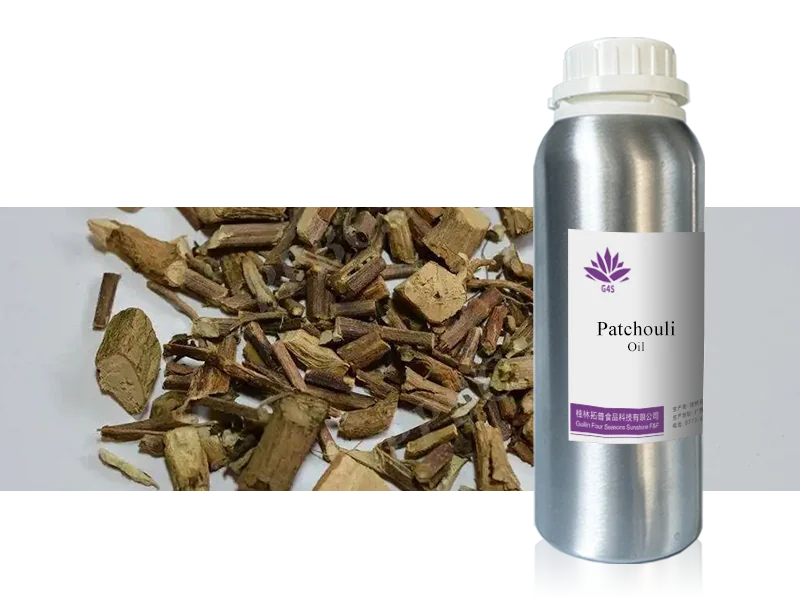
Which production standards does this patchouli oil comply with?
This patchouli oil is produced and released against a well-defined standards set that mirrors the ISO 3757 benchmark. In China it follows GB/T 3767-1999 (perfumery industry standard, equivalent to ISO 3757), the Chinese Pharmacopoeia ChP 2025 (pharmaceutical excipient and herbal oil), GB 2760-2024 entry N007 for food use, and the NMPA cosmetic catalogue No. 02634. Internationally, food-grade use is supported by FEMA GRAS 2838, and cosmetic use by INCI POGOSTEMON CABLIN OIL.
Standards Compliance
| Standard | Scope | Key parameters |
|---|---|---|
| ISO 3757:2002 | International benchmark (Indonesian type) | Patchoulol 27-35%, density 0.955-0.983, RI 1.5050-1.5120, rotation −65° to −48°, acid ≤4.0, ester ≤10 |
| GB/T 3767-1999 | China export inspection standard (≡ ISO 3757) | Patchoulol 26-33% (China-sourced profile), aligned to ISO 3757 |
| ChP 2025 (Part IV) | Chinese Pharmacopoeia excipient | Patchoulol ≥26%, density 0.955-0.985, rotation −66° to −43° |
| GB 2760-2024 (N007) | Food-use natural flavouring list | Permitted flavouring use per GMP |
| FEMA 2838 | US GRAS flavouring reference | GRAS for flavouring applications (CAS 8014-09-3) |
| NMPA catalogue No. 02634 | Cosmetic ingredient list | Whole-body leave-on up to 30% historical use record |
| INCI | Cosmetic ingredient name | POGOSTEMON CABLIN OIL (CAS 8014-09-3 / EC 616-944-7) |
How the Grades Align
- The patchoulol window differs by standard: ISO 3757 requires 27-35%, GB/T 3767 quotes 26-33% for China-sourced lots, and ChP sets the ≥26% minimum — our release spec matches the destination market and contract
- Production follows GMP with raw-material screening, batch traceability and ISO 9001-aligned quality systems
- Each batch ships with COA and GC-MS; IFRA compliance certificates are provided on request
Relate Products
This article was published on 2026-09-07, and last updated on 2026-09-07. The article will be continuously updated.