What are the physicochemical properties of patchouli oil?
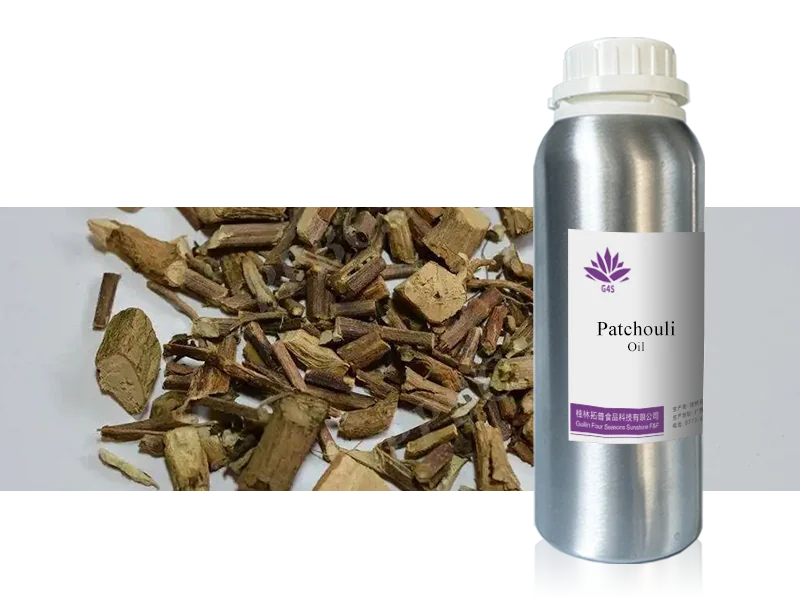
Patchouli oil is a thick, viscous liquid with a density higher than water — which is why it settles to the bottom of Florentine separators during distillation.
Typical Values
| Property | Value |
|---|---|
| Appearance | Viscous amber to dark brown-red liquid |
| Color | Dark amber to reddish brown |
| Relative density (20°C) | 0.955-0.985 |
| Refractive index (20°C) | 1.505-1.515 |
| Optical rotation (20°C) | -35° to -60° (levorotatory) |
| Flash point | 95-110°C (closed cup) |
| Solubility | Soluble in ethanol and fixed oils; insoluble in water |
| Main constituent | Patchoulol ≥26% (ChP); 27-35% (ISO 3757) |
Interpreting the Numbers
- The density of 0.955-0.985 means the oil is denser than water (about 0.96-0.985 in practice): it is one of the few essential oils collected from the bottom of the separator
- The high refractive index and high-boiling sesquiterpene content explain why distillation takes 24-36 hours and why the oil is viscous at room temperature — in cooler climates it can become sluggish or slightly cloudy and should be warmed before use
- The levorotatory optical rotation is a natural characteristic of authentic patchouli oil and is listed in pharmacopoeia and ISO monographs
What These Mean for Use
- A flash point of 95-110°C means the oil is not classified as flammable under GHS and ships as a non-dangerous good; still, keep it away from open flames and hot surfaces
- Because it is denser than water and insoluble in it, patchouli oil contains no water phase — no preservatives are needed and microbial spoilage is not a practical risk
- If the oil thickens or appears cloudy at low temperature, warm it gently to 30-40°C and mix well; the quality is unaffected
Relate Products
This article was published on 2026-09-07, and last updated on 2026-09-07. The article will be continuously updated.