What are the key aromatic compounds in this litsea cubeba oil?
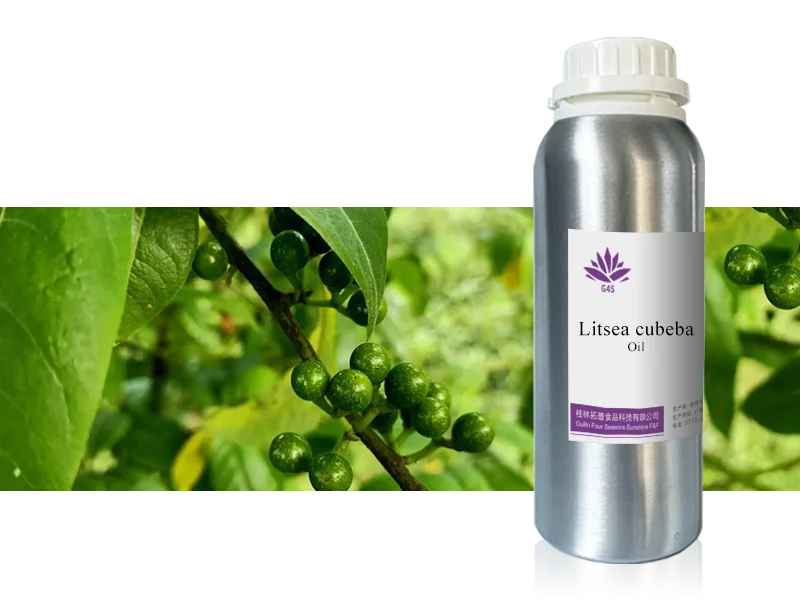
The aromatic identity of this litsea cubeba oil is built almost entirely on citral — the acyclic monoterpene aldehyde present as two geometric isomers, geranial (trans-citral) and neral (cis-citral). In a typical TPS-RO-009 batch, geranial runs about 38.70% and neral 29.40%, for a combined citral of roughly 68%, with most production lots delivering 70-80%.
Main Constituents
| Compound | Typical range | Character |
|---|---|---|
| Citral (Geranial + Neral) | 68-80% (≥68% minimum per GB 1886.35; ≥70% per GB/T 11424; ≥74% per ISO 3214; ≥75% per FCC 12) | Intense fresh lemon-citrus, the defining note |
| Limonene | ~13.9% | Light citrus peel lift, sweet orange nuance |
| Linalool | ~1.3% | Soft floral-woody freshness |
| Geraniol | ~1.1% | Rose-sweet floral, rounds the heart |
| Citronellol | ~0.2% | Rose-citrus smoothness |
| Safrole | ≤0.1% (residual) | Trace spicy note; kept to regulatory levels |
- Minor monoterpenes and sesquiterpenes (α-pinene, sabinene, β-myrcene, 1,8-cineole, nerol, β-caryophyllene) complete the chromatographic profile
- Because citral dominates, the oil behaves like a concentrated natural citral source — the reason it is the world's leading feedstock for natural citral and vitamin K synthesis intermediates
- Each batch ships with a GC-MS report showing the full fingerprint and the exact citral percentage
Relate Products
This article was published on 2026-09-07, and last updated on 2026-09-07. The article will be continuously updated.