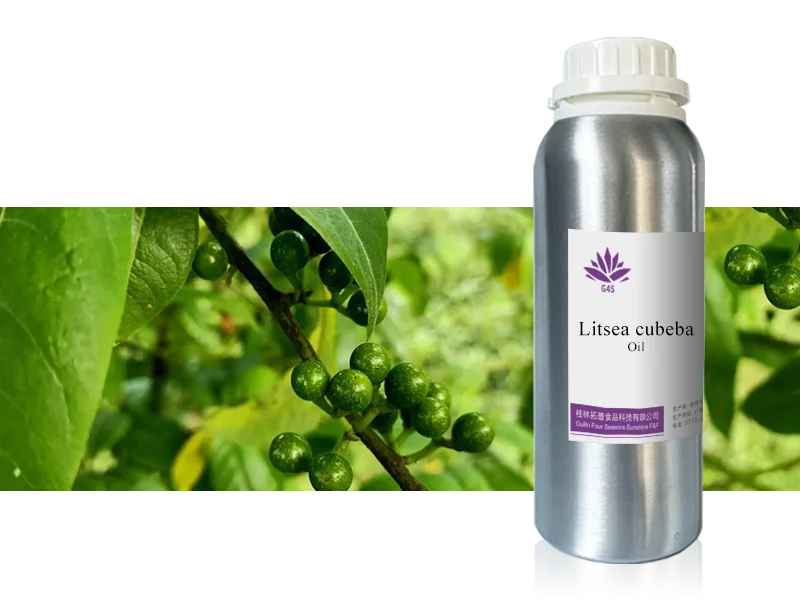
How is this litsea cubeba oil extracted?
The standard grade is produced by steam distillation of the fresh ripe berries — the classic industrial route for May Chang oil, and the one prescribed by GB/T 11424-2008, GB 1886.35-2015, ISO 3214:2000 and FCC 12. Fresh berries are loaded into 304 stainless-steel stills and treated with saturated steam; the volatile citral-rich oil is condensed, separated from the water phase and dried over anhydrous sodium sulfate.
Extraction Technology
| Method | Notes | Application |
|---|---|---|
| Steam distillation | Industrial mainstream; fresh ripe berries, saturated steam, condenser kept cool to protect citral | Food / cosmetic / FCC / ISO full production |
| Hydro-distillation | Traditional small mills; longer hot-water contact can isomerise part of the citral | Low-end household grades |
| Hydrodiffusion / cohobation | Water phase returned to the still to recover dissolved citral | Yield-improvement lines |
| Rectification (fractionation) | Vacuum column raises citral from ~70% to ≥85% | FCC / high-purity export grades |
- Oil yield is modest because citral dissolves slightly in the distillate water, so cohobation matters commercially
- The crude oil is clarified through a plate-and-frame filter before filling; every batch ships with a GC-MS report
- Rectified fractions (citral ≥85%) are supplied on request — the same feedstock used worldwide for natural citral and vitamin K synthesis intermediates
Relate Products
This article was published on 2026-09-07, and last updated on 2026-09-07. The article will be continuously updated.