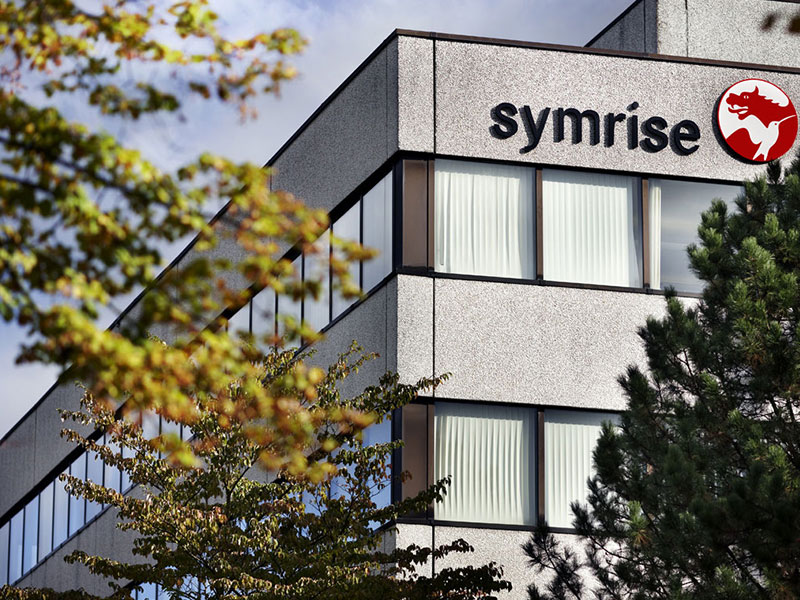
35,000 products, 10,000 natural raw materials, more than 160 countries, around 6,000 customers and over 12,000 employees — that is Symrise today. In the global flavour, fragrance and nutrition market it holds roughly 12% share and is one of the four largest suppliers. Headquarters sits in Holzminden, a small town in Lower Saxony, Germany — an industrial town that was built by one invention. In 1874 the chemists Ferdinand Tiemann and Wilhelm Haarmann found a way to synthesise vanillin and built the world's first vanillin plant here, and the site is still Symrise's global headquarters. More than a hundred years later, Dragoco, in fine fragrances and aroma chemicals, and Haarmann & Reimer merged in 2003, and the Symrise group took shape: first-year sales of USD 1.3 billion, listed in Frankfurt in 2006 in what was then the largest IPO in Germany. Today Symrise has annual sales of more than four billion euros, over a hundred production sites, and employees of around eighty nationalities.
Beyond the numbers, Symrise works in a particular way. The task it sets itself is to create taste and scent experiences that lift people, and in the laboratory that means a group of people running blind tests over a row of cups: sugar down by thirty percent, does the mouthfeel still hold? Salt pressed down, does the flavour collapse? Symrise has been working on sugar and salt reduction for many years, and it was found exactly this way, round after round of tasting. In purchasing, Symrise asks one layer more than the average customer: on top of the usual items — origin, process, residues — it also asks how the by-products of this batch of raw material are handled, whether traceability documents exist, and whether there is carbon footprint data. When Symrise brought France's Diana Group in-house some years back, a company devoted to extracting actives from the by-products of natural raw materials, you could see that this company is genuinely serious about using a raw material clean, right to the end.
The business splits into two. One is Taste, Nutrition & Health: flavours and functional ingredients for food and beverage, pet food, aquafeed, and probiotics through its holding in Sweden's Probi. The other is Scent & Care: fine fragrance and consumer fragrances, cosmetic actives, aroma chemicals. Where we connect is the natural end — natural aromatic bases and natural flavour substances, which happen to fall into Symrise's two segments respectively. Symrise's appetite on this side is well known: many varieties, many batches, fine requirements, and if one parameter does not match, dozens of formulas downstream have to move with it. The place we can fill looks like this: our advantage is not any single piece of equipment, but that the whole chain can be re-tuned on our own — from the choice of raw material plot to extraction temperature, concentration ratio and refining depth, every link is in our hands. Whatever Symrise wants adjusted, we can move it, and move it quickly.
Symrise is exacting about several things, and those happen to be the things we work on. Symrise needs any formula among its 35,000 products to survive a change of raw material batch without being rebalanced — what we do is grind the step between batches flat. Thirty years of doing it comes down to one sentence: making one good batch is not hard; the hard thing is making every batch a good one. Symrise wants the raw material used clean, right down to squeezing the by-products once more — and we believe the same thing: what is left after extraction becomes fertiliser where it can, gets extracted again where it can, and where a chemical route can be avoided, it is avoided. Symrise runs social projects in its raw-material sourcing countries and writes traceability and carbon reduction into its purchasing conditions — and we have been investing year-round in bases and growers in Guangxi; the plots, the harvest windows and the roster of partner farmers can all be pulled out on the spot. Symrise is willing to wait several years for a stable supply relationship — so are we. With natural materials, there is no rushing it.
The cooperation began with an order at pilot scale and took the better part of a year to settle. That first stretch was not smooth: several batches were sent back during Symrise's internal review, and the problem was not the figures but a drift in the aroma profile compared with the reference. For that drift we pulled out the harvest batches and extraction parameters and ran a regression, comparing stage by stage, and finally pulled the drift back inside an acceptable range. From then on the share of material we sent that passed review first time slowly climbed.
On the technology side, given Symrise's large volumes and wide range, we concentrated on two. One is aroma concentration: it enriches the effective aromatic fractions so that dosage is small and the effect controllable, which lines up well with Symrise's sugar- and salt-reduction thinking — once sugar and salt come down, flavour has to be carried by more precise aromatic substances. The other is dynamic multi-stage counter-current extraction: running several stages against the flow raises extraction efficiency and cuts the loss of actives, and for a volume like Symrise's, hundreds of batches a year, what is saved is real money. The rest — supercritical fluid extraction, Living-Fragrance physical extraction, molecular distillation and controlled release — are combined according to the requirements of each Symrise project; which variety runs which set is decided together when the specification is discussed.
On supply, several lines run in parallel, so one variety getting stuck does not hold up the whole order; bulk and samples run on the same line with no separate setup, and from a few litres to several tonnes it is the same parameter logic. Service holds no tricks either: if Symrise changes a parameter at short notice, we can schedule a pilot run the same day; technical documentation is prepared one level thicker than Symrise asks for, which saves a round of questions at audit time. Over these years, when a project is tight we work late together, when something drifts we look for the cause together, and when it works we are glad together. That way of getting along is more solid than anything else.
Looking ahead, both sides have arrangements already down to specific items: joint development of natural flavour substances, further process optimisation on existing varieties, and pushing the documentation system for sustainable sourcing another step forward. Symrise has a customer network covering the globe and its own judgement of the market; we have thirty years of extraction experience, production lines whose parameters we can tune ourselves, and the raw-material land of Guangxi. A relationship like this does not really need to be written into a contract — written into the production plan each year is enough.
This article was published on 2026-09-14, and last updated on 2026-09-21. The article will be continuously updated.