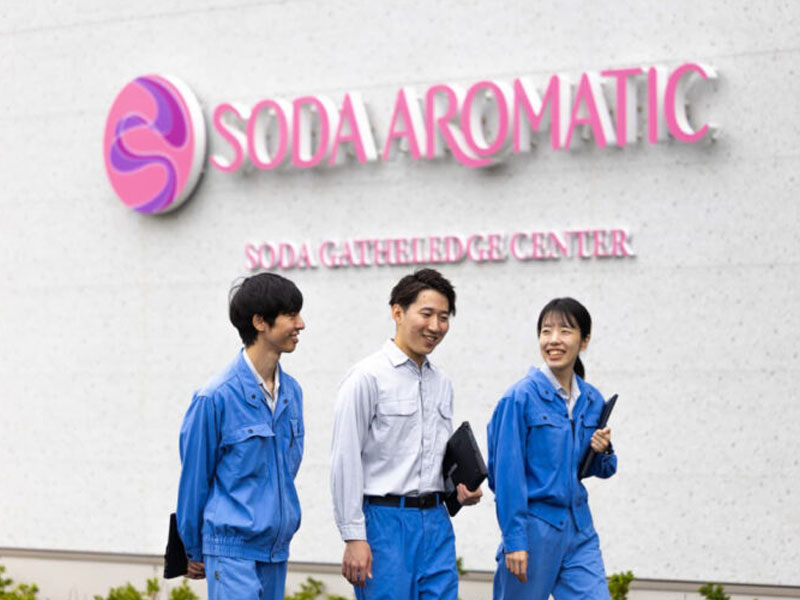
We first noticed the name Soda in an exhibitor list at an industry show, back when we had just begun sending samples into the Japanese market. Looking it up, we found the company, founded in 1915, was older than we had imagined: headquartered in Nihonbashi, Tokyo, listed on the Tokyo Stock Exchange (code 4950), and after more than a hundred years working in four areas — fragrance compounds for personal care, flavours, aroma materials, and industrial aromatic materials. The Japanese flavour and fragrance houses each have their own route: some grew up alongside the food industry, some started from aroma chemical synthesis. Soda belongs to the latter — it first established its own aroma material synthesis and production system, then extended towards both personal care and food. Over the years we have dealt with it, Soda has kept that characteristic: it understands raw materials, and it understands how to use them.
The more contact we had, the more we noticed something rather uncommon: besides the regular flavour and fragrance business, Soda also works in aromatic materials for industrial use. The logic there is completely different from composing a perfume — not to smell good, but to perform: masking, controlled release, heat resistance, longevity, and the cost still has to add up. That also shapes how Soda looks at a raw material: not "does it smell good" first, but "can it do the job in this system"; not "is it pure", but "is this purity worth this price". At first we were not used to that way of calculating and thought it made aroma too functional. Later we understood it was right: industrial orders are large and long-running, and a small cost difference multiplied across a year becomes a very real number.
The business has four parts. Fragrance compounds serve cosmetics, personal care, and fabric and home care. Flavours cover beverages, dairy, confectionery, bakery and savoury. Aroma materials covers synthetic aroma chemicals and natural aroma materials it develops and produces itself. And industrial aromatic materials covers functional aromatic products for industrial use. Where we connect with Soda is the natural end — the kind of natural material that can be used on both the personal care and the food side. Soda has its own foundation in synthesis, so if it is going to buy natural material, it has to buy it worth the money. The reason we can give is not complicated: we know every stretch of mountain in Guangxi that suits aromatic crops, and we know the temperament of those crops — which season gives a fuller aroma, which plot's material suits which process. Judgements like that do not come from reading documents; they accumulate year by year, in the fields and in the workshop.
Over these years of cooperation, Soda and we had one proper argument. It was about the purity standard for a variety. Our view was that, since we were doing naturals, purity should be taken as high as it could go. Soda did not see it that way: every point of purity added makes the cost jump a notch, and the industrial use at the end does not need it that high, so the extra money is simply wasted. Neither side convinced the other at the time. Then we each spent half a month on the numbers and found that neither was wrong — the problem was that the application had not been stated first. Material going into a food system is made to food standards; material going into an industrial system is made good enough, and the cost is saved. From then on we formed a habit: before discussing a specification, ask where it will be used at the end. That argument later became an example we use often internally: when a customer argues with you over a standard, it is usually not harshness — the accounts have not been added up together yet.
Where the two sides genuinely agree is really only a few points. First, a natural thing cannot be faked by blending; the aroma is what it is. Second, raw materials have to be invested in ahead of time — waiting until there is a shortage is too late. Third, documentation has to withstand checking: test data cannot only be written on a report, it has to match the physical goods. Three points that sound ordinary and are not easy to deliver.
The cooperation began by solving a small problem for Soda that nobody else had solved. There was a batch of material for industrial use where Soda had tried several suppliers without satisfaction; the trouble was that the aroma released too fast — a rush at the front and nothing at the back. We took it on, ran two rounds, and used controlled release to flatten the release curve. That is how it started.
The genuinely hard part came afterwards: the cost barrier. The price of natural material is what it is, and the volumes for industrial use are large, so when our first-year quotation went over, there was a stretch of silence from Soda's side. We knew the problem was not elsewhere; it was cost. So we went back and worked on the process. Between "raise the yield" and "lower the standard", we chose the former: we tuned dynamic multi-stage counter-current extraction properly and cut the loss of actives further, so that as yield rose the unit cost came down by itself. At the same time aroma concentration enriched the effective aromatic fractions, dosage fell, and Soda's actual cost in use came down with it. The trade-offs were discussed for several months: take the supercritical route to guarantee no residue but sacrifice a little yield, or take the conventional route to protect yield and add a solvent-removal step? In the end we split into two lines by application — material for food and personal care goes supercritical, material for industrial systems goes conventional with strictly controlled residue. That split is still in use today.
The rest each have their uses as well. Living-Fragrance physical extraction moves the plant's original aroma structure across intact by physical means. Molecular distillation and controlled release take purity up another notch and make the aroma release steadily and last longer. Which set goes where is decided by end use when the specification is discussed. By the time we got to the review meetings, we no longer needed to explain anything extra about the data.
On supply, delivery dates are given by the week rather than by the month, and one batch ships in several instalments so Soda does not have to hold stock. Service plays no games either: Soda's technical language is translated as it stands into words the workshop understands, and every six months we run a process review on our own initiative to push the yield up a little further. Sometimes it is not about business at all — just a phone call about how the raw material market is doing, how the harvest is on a particular plot this year. News in this trade travels slower than a quotation, and truer.
For the years ahead, the same few items sit on both calendars: joint development of several varieties, pressing cost down a little further, continued completion of sustainable sourcing documentation. Soda has its own aroma materials system and a group of long-standing customers; we have thirty years of extraction craft and the raw-material land of Guangxi. In the end, this business is not won by whoever is cheapest — it is won by whoever can be relied on.
This article was published on 2026-09-14, and last updated on 2026-09-21. The article will be continuously updated.