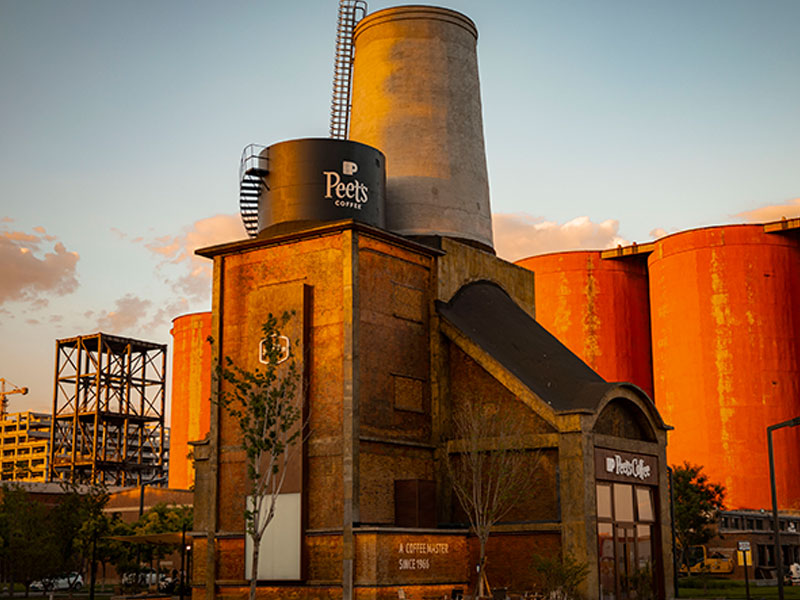
Coffee has a contradiction that cannot be got around: the darker the roast, the more aroma is lost. In 1966 Alfred Peet opened his first store in Berkeley, California, and changed American taste with dark-roasted high-quality arabica — Americans at the time were drinking light-roasted commodity beans. His dark roast later came to be called the starting point of specialty coffee, and the three original founders of Starbucks learned roasting from him. Today Peet's has moved from Berkeley to Emeryville, listed on Nasdaq in 2001, joined the JAB group in 2007, and in 2017 acquired Stumptown and Intelligentsia, becoming a vertically integrated company spanning stores, e-commerce, supermarkets, capsules and subscriptions. But the dark roast has never changed, and neither has the contradiction: for body, for caramel and cocoa character, you have to roast dark; roast dark and the delicate things originally in the bean — the florals, the fruit, the citrus notes — are mostly gone in an environment over two hundred degrees. Wanting both means someone has to bring back the part that was lost.
That job landed with us. The aroma substances of coffee are delicate by nature — from green bean to roasted bean, from bean to ground powder, from powder to cup, something is lost at every step. Thirty years of plant extraction in Guangxi is precisely the business of dealing with "delicate": which components fear heat, which fear oxygen, how to get them out in the shortest time under heat, and how to make them stay once they are out. What we supply to Peet's is the natural aroma materials for the coffee flavour line, used to modify and supplement the flavour. One precondition should be stated clearly: this is not covering up the coffee taste, it is making it more like what it should have been — restoring a little of the top, bright aroma that dark roasting lost.
Both sides earn their living by hand. Alfred Peet relied on his nose and his hands — the moment to drop the beans was smelled and seen, not calculated by a timer; Peet's still talks today about small-batch hand roasting and "the perfect cup". It is the same on our side: the veteran masters in the workshop judge whether a batch has reached the right point by smelling and looking, with instruments only as an aid. Machines can supply the effort; they cannot make the judgement. That sounds mystical; everyone in this trade understands it — the same equipment in different hands produces different results. Peet's understands, so when they look at us they do not look at the brochure; they look at "who is doing it".
The cooperation began with one concrete idea: the client wanted the dark-roasted beans to keep a little more top-layer character without changing the roast curve. The real hurdle came after — our first version of the material was made along conventional lines, and once it went into roasting, nothing was left. Roasting temperature is over two hundred degrees, and our aroma components cannot survive that; they were gone before leaving the drum. That road was closed, so it had to change: instead of adding the aroma before roasting, add it after, by spraying or blending so it adheres to the surface of the bean; and at the same time use aroma concentration to enrich the actives, plus controlled release so it adheres, does not dissipate during storage, and only comes out at brewing. After the change, the bright note on top of the bean came back, and the roast curve was not touched at all.
Talking about technology is clearest by the three forms coffee takes. The first is whole bean and freshly ground: what is needed is storage stability and oxidation resistance — the aroma must not escape before grinding and must burst out immediately after, which rests on molecular distillation pressing down the easily oxidised components and controlled release governing the pace of release. The second is capsules: something like a K-Cup has to release its aroma completely within a few dozen seconds of high-pressure extraction, and if release is too slow nothing comes out; that rests on recombining the composition by release speed and using concentration to raise the intensity. The third is cold brew and iced drinks: long extraction at low temperature, where aroma does not come out when cold — the same principle as making ice cream — which rests on concentration plus fractionation, taking the components that still volatilise at low temperature and have low thresholds. Three forms, three methods; the foundation is the same process, the proportions differ.
On supply, we follow the client's roasting batches — small batches, many batches, a few dozen kilos at a time is scheduled; different roast curves are matched by different specifications, and we make them separately rather than making the client change the curve for our material. Test data is prepared in advance too: how much of the material remains after high-temperature roasting, how much is left after three months of storage — we measure these and give them to the client first, so they know where they stand. When the client runs cupping we send someone to evaluate alongside them, note things on the spot after listening, and change things on return. Peet's people have been to our workshop too, smelled our material and told us about their roast curves — craftsmen on both sides can talk to each other.
For the years ahead, what the two sides need to do together is clear: make the flavour supplementation on the dark roast line finer, tune the release rhythm for capsules and cold brew more precisely, and widen the range of natural raw material varieties. A good cup of coffee is known by the nose first — that sentence has come down at Peet's since 1966, and we have been saying it on our side for thirty years.
This article was published on 2026-09-14, and last updated on 2026-09-21. The article will be continuously updated.