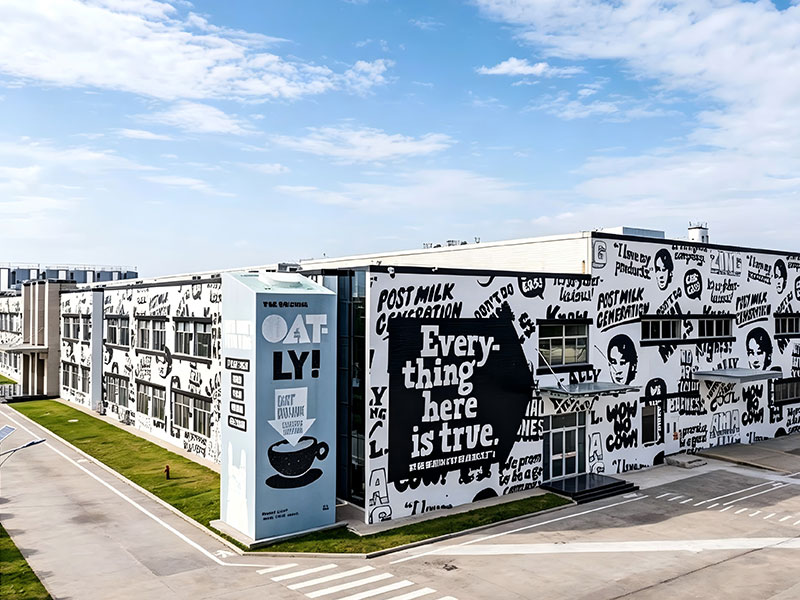
Oatly has done something that makes peers uncomfortable: printing the climate footprint data of its products on the packaging. Carbon emissions, water use, written out plainly for you to see, with no fear of comparison. That move turned the word "transparency" from a slogan into a hard constraint — once you print the data you are accountable for it, and once you are accountable for it you have to manage all the way upstream. Oatly was formally established in Malmö, Sweden, in 1994, growing out of Rickard Öste's research at Lund University: how to turn oats into a nutritious, milk-like drink. For twenty-odd years it was just a small Nordic brand; around 2012 it changed tack — the packaging started speaking like a person, in a bold voice; around 2018 Barista Edition broke into specialty coffee shops in Europe and America and overnight became the barista's first choice; in 2021 it listed on Nasdaq. Today its products sell in more than sixty countries, with plants in Sweden, the Netherlands, the United States, the United Kingdom, China and Singapore. Its range — oat drink, Barista Edition, oat ice cream, oat yoghurt, cooking cream — turns entirely around oats.
The oat strand has one hurdle that cannot be got round: oats carry a cereal note of their own, which some call "oaty" and others say is like overcooked porridge. If that note cannot be held down, the product does not sell; press it too hard and the oats lose their own face. What we supply to Oatly is the natural aroma materials for these lines. Interestingly, when talking technology with this company, the first thing agreed was something that looks unrelated to aroma — the shorter the ingredient list, the better. Oatly's ingredient lists have always been short, one item fewer whenever possible; our process runs the same way: one step fewer whenever possible, no solvent, no modification, no chemical treatment. Supercritical fluid extraction brings no solvent into the process, Living-Fragrance physical extraction adds no foreign modification — together, our material is itself very "short".
The understanding between the two companies is that both believe "less is more". Less does not mean saving; it means restraint: no unnecessary additions, no unnecessary treatment, no unnecessary modification. Everyone today is doing addition — more functions, more flavours, more selling points — yet the things that genuinely taste good are often what is left after the excess is removed. Thirty years in plant extraction has slowly taught us exactly that: save a process step wherever possible, because every extra step means one more loss and a little more off-note. Oatly printing its carbon footprint on the pack is essentially the same thing — take away what is superfluous and what remains is real. When two companies like that sit down to talk, they rarely argue, because the standard for what to keep and what to drop is the same.
The cooperation began with an oat drink. The client's requirement was specific: the cereal note should not steal the show, but people should still know it is made from oats. The real hurdle came after — they wanted a sugar-free version. Sugar is not only the source of sweetness; it also carries the aroma: in a sweetened drink the aroma seems thicker and rounder; remove the sugar and the same aroma becomes thin and floaty, as if it has no base. We tried several times; adding more did not help, and adding more made it "falsely fragrant". The answer in the end was to adjust the composition rather than the dosage: use aroma concentration to enrich the middle and back fractions, restoring the "thickness" of the aroma, and at the same time use molecular distillation to press down the components that seem sharp in a sugar-free system. After the change, the sugar-free version drank as the same aroma as the sweetened one, not a version with "something missing".
Talking about technology is clearest by three things beyond aroma — a natural aroma material in an oat product does more than govern smell. The first is mouthfeel: oat drink tastes "thin", and aroma can supply part of the sense of "thickness", resting on the roundness carried by the enriched middle fractions. This is not an illusion; it is the actual contribution of aroma to mouthfeel. The second is colour: oat products are particular about clean colour, and material carrying colour changes the appearance, so molecular distillation presses down pigments and heavy boiling components to make a light-coloured version. The third is compatibility with coffee: the Barista Edition has to foam, go into high-temperature steam, and not curdle in acidic coffee, which rests on pushing refining depth up so the material stays stable under high acid and high temperature. The smell itself is, by contrast, the easiest thing to solve: Living-Fragrance physical extraction plus supercritical fluid extraction take the plant's original aroma structure out intact, so the cereal note is held down and the oats keep their own face.
On supply, Oatly has plants in several countries and we supply them separately to the same specification, so whichever plant receives it, it is the same; the client's new product rhythm is fast, so we run small-batch quick response rather than pushing small volumes to the back of the queue. On service, the client does transparent disclosure and we prepare the upstream material — plots, harvest season, process route, energy data, everything that can be given is given, so the numbers they print on the pack have a source; for the sugar-free and low-sugar ranges we adapt the formulation rather than simply reducing the sweetened material. Oatly's sustainability team has been to our bases and talked about grower cooperation — they genuinely care about that side; they did not come for photographs.
For the years ahead, what the two sides need to do together is clear: make the aroma body on the sugar-free line more substantial, tune the low-temperature release for the ice cream and yoghurt areas, and make the upstream sustainability data finer. The shorter the ingredient list, the more every item has to stand up — Oatly prints that on the pack, and we write it on the process card.
This article was published on 2026-09-14, and last updated on 2026-09-21. The article will be continuously updated.