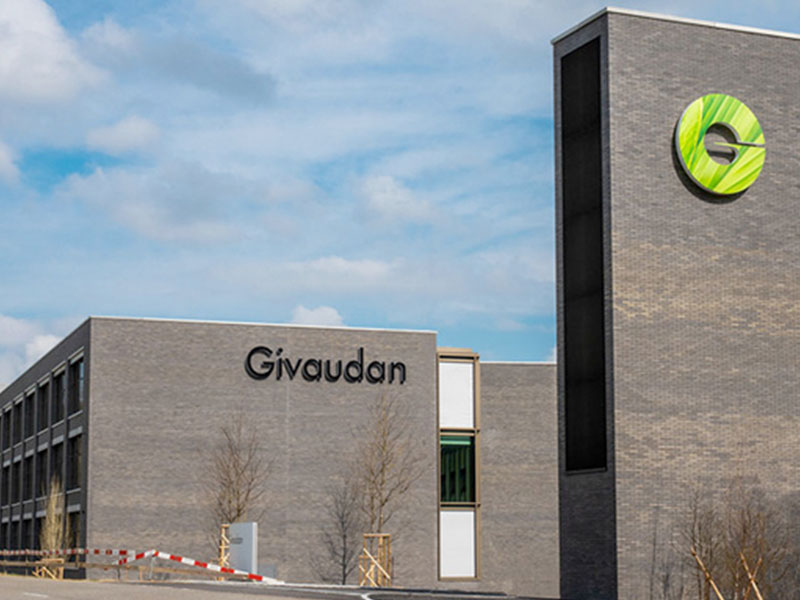
The first time Givaudan's audit team came to our plant was several years ago. Half the questions they asked that day had nothing to do with aroma: which plot did this batch of raw material come from, who grows it, how long after harvest did it go into the tank, was the equipment running the same variety on the previous batch. The engineer leading the group crouched in the raw material store turning bags over, and when he finished he looked up and asked: "How do you make sure that a year from now, it still smells the same?" That sentence later became an example we quote often in our own internal training. And it was from that first contact that we really came to know this company.
Givaudan's history reaches back to Antoine de Chiris in Grasse, France, in 1768 — he started by collecting material from the flower fields and built it, step by step, into a supplier no perfume house could do without. In 1895 the brothers Léon and Xavier Givaudan set up in Switzerland; when the bakery next door complained that the violet smell drifting out of the laboratory was too strong, they moved the works to Vernier outside Geneva in 1898. The hundred years after that were a steady run of acquisitions and integration: acquired by Roche in 1963, merged with Roure in 1991, listed independently on the Swiss exchange in 2000, took over Quest International in 2007, and in 2019 brought in seven companies at once, among them Albert Vieille and Ungerer. Albert Vieille, a Grasse house that had spent decades on natural essential oils and absolutes, says more than anything else about how much Givaudan values naturals. By 2025 Givaudan has 167 sites worldwide and 77 production facilities, more than 17,500 employees, sales of CHF 7.5 billion, and roughly 18% of the global market — a very firm hold on first place in the industry.
The sentence Givaudan uses about itself is "Human by nature" — from nature, for people. What stands behind it is real spending: around 10% of turnover goes into R&D every year; the perfumery school founded by perfumer Jean Carles in 1946 is still running outside Paris; the AI formulation tool Carto and the Digital Factory innovation accelerator are both part of everyday work now. What we have felt most strongly in the cooperation is that Givaudan is willing to lay its cards on the table. Rarely does it simply throw a specification sheet across and wait for a price — it explains the background of the need, the application target and its own internal evaluation criteria first, so that everyone can discuss it together. The more complete the information, the more thinking we can do, and the more likely the proposal lands right the first time.
On the business side Givaudan divides into two. Taste & Wellbeing looks after what goes into the mouth, across four directions — savoury, beverages, sweet goods and dairy — from ready meals, snacks, soups and sauces to soft drinks, juices, confectionery, bakery, ice cream and yoghurt. Fragrance & Beauty looks after what you smell and what goes on the body: fine fragrance, personal care, fabric care, hygiene, home care and beauty. Where we overlap most deeply is upstream of both — the aroma substances of natural origin, and the plant extract fractions that can be used on the food side. The natural floral and woody bases in fine fragrance, the substantivity and stability a household fragrance needs, the "natural flavour" that food and beverage customers are asked about more and more — at the very top of the chain none of it gets around this layer. What lets us take it on is the raw material network we have built over thirty years of plant extraction in Guangxi: which hillsides suit which crop, which season to harvest, how many hours after picking it has to go into the tank — these are things you cannot buy with money. On top of that, the whole chain from extraction and refining to application testing is in our own hands, so changing one parameter shows a result the same day.
Talking about principles is easy to keep vague; you only see the difference in what actually gets done. Among the things Givaudan has been pushing in recent years, one is raising natural content. The higher the natural proportion in a formula, the more easily any variation in the raw material itself gets magnified — a small deviation can be smelled by the consumer at the end. So the demand for batch consistency goes right down to the bone. The other is sustainability: Givaudan joined RE100 back in 2015 and has committed to 100% renewable electricity by 2025 and net zero by 2045 — and targets like these always land, in the end, on the origin and the process at the raw material end. Then there is the willingness to spend time on co-creation: 10% of revenue going into R&D every year, plus an open innovation network aimed at start-ups and suppliers. That way of working is the same road as our own patience of "get the process right first, then talk business". The three things Givaudan asks for happen to be the three things we have been sharpening for thirty years.
The cooperation between us began with a box of samples, and the specification went back and forth three times before it was settled. The real turning point happened on the process, and the comparison makes it clearest. In the beginning, handling aromatic plants meant soaking and steam distillation: the yield was good, but after a pass at high temperature the top note was basically gone, and you had to compensate for it later in the formulation. Later we moved to Living-Fragrance physical extraction — the temperature comes down, the plant keeps its own character, and there is far less to patch up in the formula. Solvent followed the same path: the old process extracted with solvent, paste yield was high, but residue was always a tail you could never quite explain away. Supercritical fluid extraction runs at low temperature throughout and leaves no solvent behind; the yield is a little lower, but the word "natural" stands up. Aroma concentration and dynamic multi-stage counter-current extraction solve the two other ends — the former enriches the effective aromatic fractions so dosage is easier to control, the latter raises efficiency while losing less of what matters. Molecular distillation and controlled release close it out, pushing purity further and making the release steadier and the scent last longer. After the change, the material we sent came back from Givaudan's re-evaluation cleaner each time, impurity peaks fewer and fewer, and purity, colour and aroma stable over the long run — never a case that needed rework. On supply, the workshop handles both a run of tens of kilos and one of over ten tonnes; the only difference is scheduling, and capacity is locked in ahead of the peak season, so Givaudan never has to scramble for it. On service, when Givaudan raises a custom request, we do not let it sit overnight — there is a first direction the next morning, and the R&D people on both sides talk to each other directly without going round through commercial staff. Over these years, Givaudan's people have come to Guangxi to look at the bases, and our people have spent time sitting in Givaudan's laboratories; the visits have grown more frequent, and it long ago stopped feeling like two companies dealing with each other.
Looking further ahead, both sides think the same way: joint screening of new materials, shared optimisation of processes, and preparation before regulatory changes are all on the calendar. Givaudan has its judgement of global consumer trends and a level of R&D investment rarely seen in this industry; we have thirty years of extraction experience, a technology system that keeps evolving, and capacity that is really there. Whether this goes far from here depends on whether both sides are still willing to keep putting in — and on that point, neither Givaudan nor we have any intention of easing off.
This article was published on 2026-09-14, and last updated on 2026-09-22. The article will be continuously updated.