GB 1886.274: National Standard for Chrysanthemum Oil
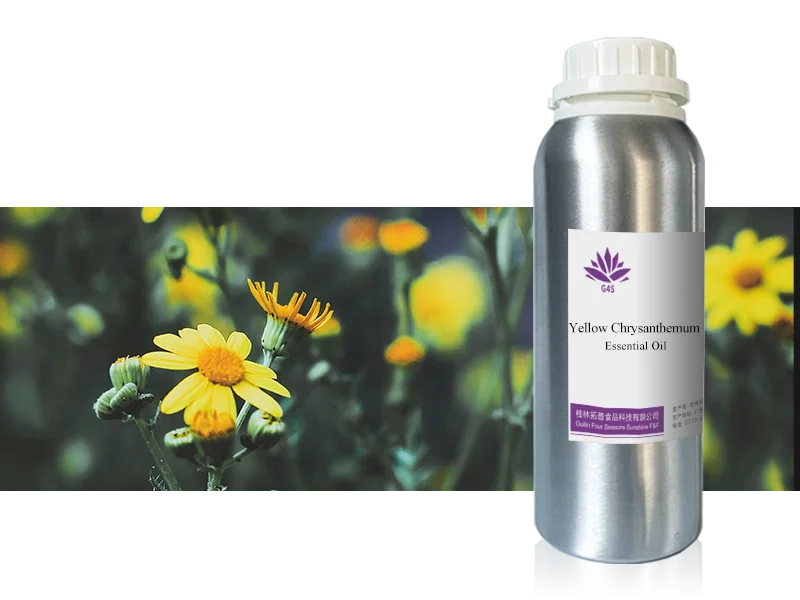
GB 1886.274-2016, National Food Safety Standard — Food Additives — Hangbaiju Chrysanthemum Oil, is the national-level credential that provides authoritative answers to the specification questions international buyers face when sourcing this natural flavor from China. The standard was jointly issued on August 31, 2016 by the National Health and Family Planning Commission of the People's Republic of China and the China Food and Drug Administration, reviewed and approved by the National Food Safety Standards Review Committee, published under Announcement No. 11 of 2016 of the National Health and Family Planning Commission, and implemented from January 1, 2017 (see the announcement page of the Department of Food Safety Standards, Risk Surveillance and Assessment of the National Health Commission). As one of the main drafting units of this standard, Guilin Four Seasons Sunshine F&F Co., Ltd. participated deeply in the entire drafting process, making its specification sheets intrinsically consistent with the national-level text at the technical-indicator level — providing international buyers with a specification basis independent of supplier self-declaration and verifiable on the official national website.
I. Why a Chinese National Food Safety Standard Matters to International Importers
When a food ingredient procurement director based far away in Europe, North America, or the Middle East reviews a "Hangbaiju chrysanthemum oil" specification sheet submitted by a Chinese supplier, three uncertainties that are difficult to independently verify usually lie before him. First, whether the product specification is backed by a national-level standard — whether the relative density range, refractive index range, and acid value and ester value limits stated by the supplier are a unilateral enterprise declaration or are endorsed by a national-level specification text. Second, whether the Chinese national standard connects with international standards — whether the correspondence between the GB standard and international flavor authority systems such as ISO, FEMA, and IFRA is clear and traceable. Third, whether the supplier is a participant in making the standard or only an executor of it — a main drafting unit, or a company merely citing rules made by others. These three uncertainties are precisely the most common, and the hardest to self-prove, compliance blind spots for international importers sourcing natural flavors across borders.
GB 1886.274-2016, National Food Safety Standard — Food Additives — Hangbaiju Chrysanthemum Oil, is precisely the national-level credential that provides authoritative answers to these three uncertainties. It was jointly issued by the National Health and Family Planning Commission of the People's Republic of China and the China Food and Drug Administration on August 31, 2016, reviewed and approved by the National Food Safety Standards Review Committee, published pursuant to Announcement No. 11 of 2016 of the National Health and Family Planning Commission, and implemented from January 1, 2017. Guilin Four Seasons Sunshine F&F Co., Ltd., as one of the main drafting units, participated deeply throughout the standard's compilation, making its specification sheets intrinsically consistent with the national-level text at the technical-indicator level — this provides international buyers with a specification basis independent of supplier self-declaration and verifiable on the official national website.
II. Origin and Authority of the Standard
The legal basis of GB 1886.274-2016 is Article 26 of the Food Safety Law of the People's Republic of China on national food safety standards, together with the procedures for standard formulation regulated by the Administrative Measures for National Food Safety Standards. The issuing authorities are the National Health and Family Planning Commission of the People's Republic of China and the China Food and Drug Administration; the review body is the National Food Safety Standards Review Committee, the sole statutory review body for national food safety standards at the national level, composed of experts in medicine, food, nutrition, agriculture, and quality supervision, and responsible for project initiation recommendations, review, and re-review of standards.
The standard was published under Announcement No. 11 of 2016 of the National Health and Family Planning Commission, which released a batch of 243 national food safety standards and 2 standard amendment sheets, GB 1886.274-2016 among them. The issue date is August 31, 2016 and the implementation date is January 1, 2017; from the implementation date onward it serves as the sole statutory specification basis for the production, import, inspection, and supervision of the food additive Hangbaiju chrysanthemum oil.
GB 1886.274-2016 is one of the supporting standards of GB 2760-2014, National Food Safety Standard — Standard for the Use of Food Additives. GB 2760 prescribes the permitted varieties, scopes of use, and maximum use levels of food additives, while the GB 1886 series prescribes, one by one, the quality specification standards for each food additive — the former answers "whether it may be used and how much," and the latter answers "what a qualified product looks like." Together they form the complete closed loop of Chinese food additive compliance.
The standard drafting process strictly follows six steps: project initiation → drafting → public consultation → review → promulgation → implementation. Project plans are issued by the National Health and Family Planning Commission; drafting is undertaken by professional institutions and major manufacturers in the industry, producing a consultation draft; the consultation stage solicits comments from the public and from industry experts simultaneously; at the review stage the National Food Safety Standards Review Committee organizes expert review; after approval the standard is jointly issued and announced by the National Health and Family Planning Commission and the China Food and Drug Administration; and the implementation date reserves a transition period of about four months for manufacturers to adjust processes and quality control systems.
III. Technical Requirements of the Standard
The table below lists the core technical requirements of GB 1886.274-2016 item by item, translating each indicator into "due diligence implications for international buyers," so that overseas importers can use it directly during supplier due diligence and batch acceptance.
| Dimension | Standard Requirement | Due Diligence Implication for International Buyers |
|---|---|---|
| Standard number | GB 1886.274-2016 | The number can be verified on the National Health Commission website and entered as the fixed "national standard number for product specification" field in the Vendor Qualification Checklist |
| Standard name | National Food Safety Standard — Food Additives — Hangbaiju Chrysanthemum Oil | Corresponds one-to-one with the supplier's specification sheet, COA, and customs declaration product name, eliminating "similar-name" deception |
| Raw material requirement | Flowers of Hangbaiju chrysanthemum (Dendranthema morifolium or Chrysanthemum morifolium) | Explicit botanical binomial nomenclature, aligned with the ISO 4720 and FEMA coding systems, preventing substitution by industrial chrysanthemum or dyed chrysanthemum |
| Process requirement | Steam distillation | Restricts extraction to a physical process, eliminating chemical solvent residue risk; corresponds to the "physical process" criterion in IFRA's natural/synthetic definition, falling within the natural-process scope |
| Sensory requirement — color | Greenish-yellow to light brown | Judged by visual comparison in color-comparison tubes; usable as a rapid incoming screening item; out-of-range color signals process or raw material abnormality |
| Sensory requirement — state | Liquid | Rules out crystallization, phase separation, or solid impurities; serves as an intuitive quality gate |
| Sensory requirement — odor | Characteristic odor of Hangbaiju chrysanthemum flowers | GB/T 14454.2 odor evaluation method; subjective but cross-verifiable by perfumers to detect adulteration |
| Relative density (25 °C/25 °C) | 0.936–1.000 | Determined per GB/T 11540; out-of-range density indicates compositional deviation or adulteration; usable as a quantitative screening indicator |
| Refractive index (20 °C) | 1.490–1.523 | Determined per GB/T 14454.4; refractive index is highly sensitive to compositional changes and is a classic indicator for detecting adulteration |
| Miscibility (20 °C) | 1 volume of sample is miscible with 3 volumes of 95% (v/v) ethanol, giving a clear solution | Determined per GB/T 14455.3; reflects the proportion of polar components in the oil; abnormal miscibility indicates adulteration or process deviation |
| Acid value (as KOH) (mg/g) | ≤ 50 | Determined per GB/T 14455.5; an excessive acid value indicates oxidative deterioration or excess free acids, affecting shelf life and aroma stability |
| Ester value (as KOH) (mg/g) | ≥ 50 | Determined per GB/T 14455.6; the ester value quantitatively reflects the characteristic aroma components of Hangbaiju chrysanthemum; too low a value indicates insufficient characteristic components |
| Heavy metals and total arsenic limits | Not separately specified in this standard; the general requirements of GB 2762, National Food Safety Standard — Limits of Contaminants in Food, apply | Buyers should simultaneously request GB 2762 compliance reports and require third-party test data for heavy metals (as Pb) and total arsenic (as As) from the supplier |
IV. Practical Value for International Buyers
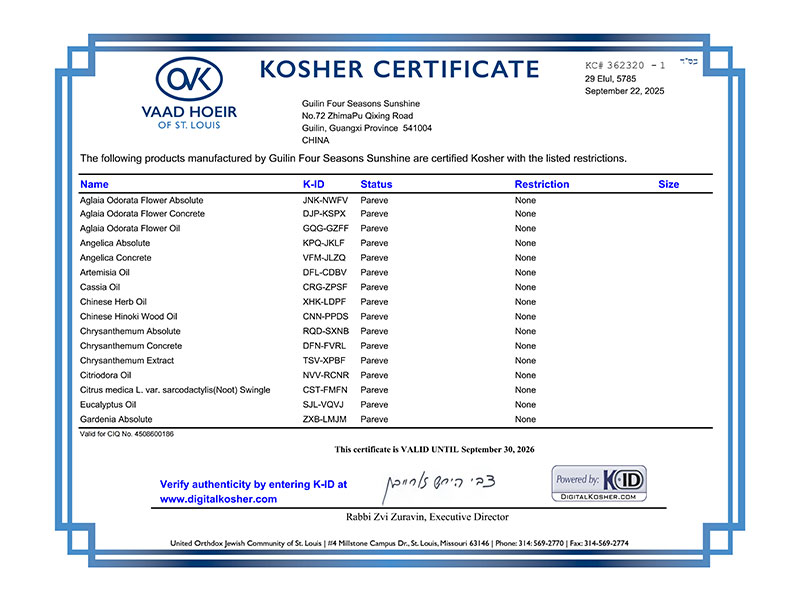
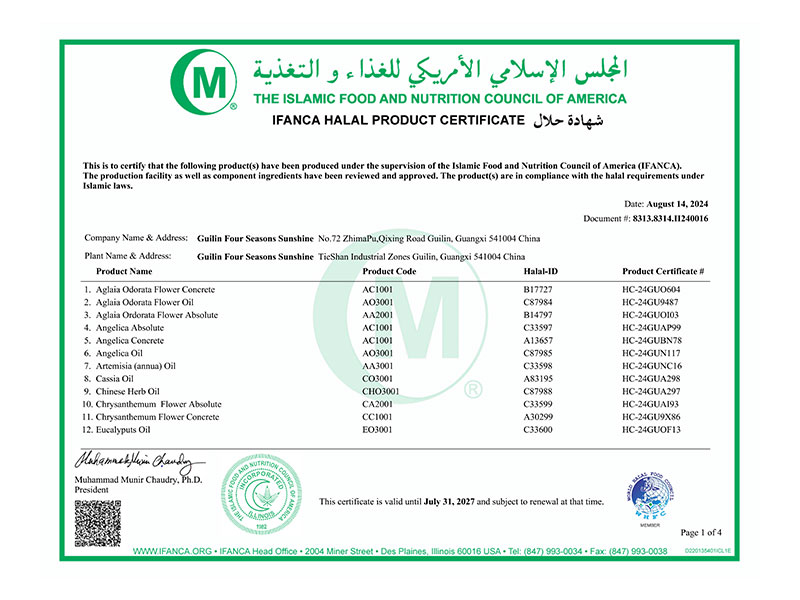
First, providing a product specification basis independent of supplier self-declaration. The GB 1886.274-2016 standard number can be verified on the National Health Commission website; buyers can write the standard number, sensory requirements, and physicochemical indicator ranges directly into their Vendor Qualification Checklist and incoming acceptance standards as a third-party specification basis independent of supplier self-declaration. This forms a complete evidence chain together with the complementary matrix constituted by Guilin Four Seasons Sunshine F&F's previous seventeen certificates: those seventeen certificates already cover seventeen dimensions — High-Tech (technology) / Forestry (resources) / President Unit (regional standing) / Statistics (data) / Qiushi Award (R&D team) / Top Ten (operating strength) / Council Member Unit (governance participation) / FFC2026 (R&D implementation) / Business License (legal existence) / Food Production License (statutory qualification) / ISO 22000 (system compliance) / Naturalness (natural-attribute certification) / IFANCA Halal (multi-country Muslim markets) / BPJPH Halal (Indonesian market) / Kosher (Jewish market) / FSA (farm sustainability); whereas the GB 1886 series national standard certificates address the eighteenth dimension — "national-standardization of product specifications and participation in standard formulation," namely upgrading the supplier's specification sheet from an enterprise declaration to national-level textual endorsement.
Second, providing verifiable evidence of alignment between national and international standards. In its botanical raw material nomenclature, GB 1886.274-2016 adopts the binomial names Dendranthema morifolium and Chrysanthemum morifolium, directly corresponding to the nomenclature and process criteria for chrysanthemum-genus essential oils in the international essential oil standard ISO 4720, the FEMA GRAS coding system, and IFRA standards. Buyers can compare the GB standard item by item with the international standards of their target markets, building a "national standard — international standard" comparison table as an objective basis for compliance consistency assessment.
Third, providing verifiable evidence that the supplier participated in drafting the standard. As a main drafting unit of GB 1886.274-2016, Guilin Four Seasons Sunshine F&F's product specification sheets are intrinsically consistent with the national standard's technical indicators at the indicator-design level — a consistency that stems from the drafting unit's direct participation in the standard's technical parameters rather than passive post hoc compliance. During due diligence, international buyers may ask the supplier for proof of drafting-unit status, meeting minutes of the compilation work, or corroborating announcements, as verifiable evidence of a "standard-making participant" rather than a "passive executor."
Fourth, providing institutional assurance of continuing standard compliance. GB 1886.274-2016 has remained in force since its implementation on January 1, 2017, and forms a complete compliance closed loop together with GB 2760-2014, GB 2762, and the GB 5009 series of test method standards. This institutional assurance interfaces with international compliance frameworks such as FDA 21 CFR, the EU Flavoring Regulation, and ISO 4720, enabling international buyers to use Chinese national standards as a foundational data source for target-market compliance assessment in cross-border procurement, reducing duplicate testing and duplicate certification costs.
V. About Guilin Four Seasons Sunshine F&F
1. Product Portfolio
Guilin Four Seasons Sunshine F&F Co., Ltd., founded on August 30, 2007 and headquartered in Lingchuan County, Guilin, Guangxi, has built four product matrices around natural flavors and functional food ingredients:
| Category | Representative Products | Typical Applications for International Buyers |
|---|---|---|
| Natural Absolutes | Osmanthus absolute, jasmine sambac absolute, Michelia alba flower oil, Michelia alba leaf oil, Aglaia odorata flower oil, Hangbaiju chrysanthemum oil | High-end flavor compounding, natural fragrance-note ingredients, food flavor modification |
| Natural Essential Oils | Hangbaiju chrysanthemum oil, osmanthus essential oil, jasmine essential oil, gardenia essential oil | Food additives, flavor raw materials, aromatherapy raw materials |
| Supercritical CO₂ Extracts | Osmanthus CO₂ extract, monk fruit CO₂ extract | High-end natural ingredients, retention of heat-sensitive components |
| Osmanthus Concentrate & Functional Food Ingredients | Osmanthus concentrate, monk fruit tincture, mogrosides | Beverages, bakery, seasonings, functional foods |
2. Process and Quality Infrastructure
- Multi-process parallel capability: four core processes run in parallel — steam distillation, solvent extraction (tinctures), supercritical CO₂ extraction, and concentration — covering all mainstream process routes involved in the GB 1886 series;
- Clean production and GMP system: implements GB 14881, National Food Safety Standard — General Hygienic Specification for Food Production, with intelligent clean workshops and full-process quality control points;
- Testing capability: equipped with gas chromatography (area normalization method), high-performance liquid chromatography, and the full set of general flavor testing equipment for relative density, refractive index, and miscibility, enabling in-house control testing of all technical indicators of GB 1886.274-2016;
- Intangible cultural heritage craft transmission: the traditional osmanthus scent-preservation craft and the blended-incense making craft are listed as autonomous-region-level intangible cultural heritage, serving as the traditional fragrance foundation for modern extraction processes.
3. International Certification Matrix
| Certification | Issuing Body | Application Scenario for International Buyers |
|---|---|---|
| ISO 22000 | International food safety management system | Foundation of system compliance for global markets |
| Halal IFANCA | Islamic Food and Nutrition Council of America | Market access for Muslim markets in multiple countries |
| Halal BPJPH | Ministry of Religious Affairs of Indonesia | Statutory market access for Indonesia |
| Kosher | Kosher certification body | Market access for Jewish markets |
| FSA | Farm sustainability assessment | Sustainable procurement and ESG due diligence |
| Food Ingredient Naturalness certification | Chinese food ingredient industry organization | Third-party endorsement of natural attributes |
| Autonomous-region-level intangible cultural heritage | Department of Culture and Tourism of Guangxi Zhuang Autonomous Region | Endorsement of traditional craft |
4. Extended Value of This Standard for Buyers
- Specification sheets and the national standard share the same source: as a main drafting unit of GB 1886.274-2016, Guilin Four Seasons Sunshine F&F's Hangbaiju chrysanthemum oil specification sheets are compiled from the same source as the national standard's technical indicators, so buyers no longer need to perform "enterprise specification vs. national specification" difference comparisons during COA verification;
- In-house control of batch stability: the standard's technical indicator system is embedded in the enterprise's in-house control process; every batch is tested on release by the full method set GB/T 11540, GB/T 14454.4, and GB/T 14455.3/5/6, and COA data can interface directly with international buyers' incoming acceptance systems;
- One-stop cross-border compliance: national standard number + ISO 22000 + Halal + Kosher + FSA + naturalness certification constitute a multi-market compliance matrix, allowing buyers to complete qualification verification for multiple target markets in one pass.
5. Verification Elements Checklist for International Buyers
| Verification Item | Verification Channel | Key Points to Verify |
|---|---|---|
| Validity of the national standard number | National Health Commission official website | Standard number, issue date, implementation date, status (current) |
| Drafting-unit identity | Foreword of the standard text / corroborating announcement | Guilin Four Seasons Sunshine F&F Co., Ltd. listed as a main drafting unit |
| Legal existence of the business | National Enterprise Credit Information Publicity System | Business license, date of establishment, legal representative, registration status |
| Food production license | Provincial market regulation authority publicity | Food production license number, detailed categories, validity period |
| System certification | Certifier website or CNAS publicity | ISO 22000 certificate number, certification body, validity period |
| Halal / Kosher | Issuing body website | Certificate number, validity period, covered products |
| Batch COA | Supplier + third-party testing laboratory | All indicators correspond to all physicochemical items in Table 2 of GB 1886.274-2016 |
This article was published on 2026-09-12, and last updated on 2026-09-20. The article will be continuously updated.