From Guilin to Kosher Tables Worldwide
Kosher certification is the religious and dietary compliance credential issued after conformity assessment against the standards of Jewish dietary law (Kashrus), issued by Kosher certification bodies authorized by a rabbinical court (Beth Din) after assessment against the dietary rules of the Torah and the Talmud, and serves as the religious and dietary compliance credential for market access to Jewish consumer markets worldwide. There are currently more than 1,100 Kosher certification bodies globally; OU Kosher, under the Orthodox Union (OU) of the United States, was founded in 1923 and is the world's largest Kosher certification body, certifying more than 1.3 million products and covering more than 15,000 production facilities in 106 countries; OK Kosher is the world's largest independent kosher certification body; Star-K is one of the world's leading non-profit Kosher certification bodies and maintains a Shanghai office in China providing Chinese-language consulting services to Chinese enterprises (OU Kosher Certified Company Search). The Kosher certification system divides foods into three categories — Meat, Dairy, and Pareve — and provides a special Passover certification; certification symbols (such as OU, OK, and Star-K) are the visual signs by which consumers worldwide identify Kosher products. The Kosher certificate held by Guilin Four Seasons Sunshine F&F Co., Ltd. was issued after conformity assessment against Jewish dietary law standards by an internationally recognized Kosher certification body, and the certificate information can be independently verified by certificate number or enterprise name on the relevant certification body's official website. For international importers sourcing Chinese natural plant extracts and food ingredients for the European, American, Southeast Asian, and Middle Eastern markets, this Kosher certificate issued by a Kosher certification body is an independently verifiable supply chain signal focused on the dimension of "Jewish consumer market access and religious dietary compliance."
I. Why a Kosher Certificate Matters to International Importers
When international buyers evaluate Chinese suppliers of natural plant extracts and food ingredients, they commonly face three uncertainties related to "Jewish consumer market access": first, the authenticity of Kosher compliance — whether the supplier's self-positioning as "Kosher Certified" has been assessed as conforming against Jewish dietary law standards by a certification body authorized by a rabbinical court, rather than being mere market rhetoric; second, the international recognition of the certification body — whether the supplier's Kosher certification is issued by a body whose symbol is widely recognized by consumers worldwide (mainstream bodies such as OU, OK, and Star-K), and whether the certificate is accepted in North American and global Jewish consumer markets rather than being issued by an unknown body; third, the match between Kosher classification and the supplied categories — whether the supplier's Kosher-certified products are classified as "Pareve" — neither meat nor dairy, and consumable with both meat and dairy products — the classification most suitable for natural plant extracts and food ingredients, and whether there is documented classification confirmation.
The Kosher certificate is precisely the internationally accepted credential that provides authoritative answers to these three Jewish market access uncertainties. Its value lies not in the paper certificate itself, but in the certification system behind it — assessment against the dietary rules of the Torah and the Talmud by a Kosher certification body authorized by a rabbinical court, with assessment criteria covering raw material compliance, production equipment cleanliness, process flows, cross-contamination control, and ingredient list verification; certificates are publicly verifiable on the certification body's official website, and any third party may independently query by certificate number or enterprise name.
The Kosher certificate held by Guilin Four Seasons Sunshine F&F Co., Ltd. was issued after conformity assessment against Jewish dietary law standards by an internationally recognized Kosher certification body, meaning that its raw materials, production equipment, process flows, and cross-contamination controls have been confirmed by the Kosher body's on-site audit as conforming to Kashrus standards, providing international buyers with a Jewish market access endorsement that is independently verifiable and goes beyond supplier self-declaration.
II. Origin and Authority of the System
Origins of Jewish Dietary Law
Kashrus, the Jewish dietary law, dates back more than 3,300 years to the time of Moses and originates in the dietary rules of the Torah and the Talmud. The word "Kosher" comes from Hebrew meaning "fit or proper," referring to foods conforming to Jewish dietary law. The dietary laws specify in detail the types of food Jews are permitted to eat and how they must be prepared, including:
- Permitted and prohibited animals: only mammals that both chew their cud and have split hooves (such as cattle and sheep) are Kosher; pigs, camels, and rabbits are non-Kosher; only fish with both scales and fins are Kosher; shellfish and crustaceans are non-Kosher;
- Meat-dairy separation: Meat and Dairy products may not be eaten together, processed together, or share utensils;
- Slaughter rules: animals must be slaughtered according to Shechita rules by an authorized Jewish slaughterer (Shochet), with a blessing recited during slaughter;
- Ingredient compliance: all ingredients must conform to Kosher standards and may not contain non-Kosher components (such as non-compliant gelatin sources or non-compliant alcohol sources).
The Three Kosher Categories
The Kosher certification system divides foods into three categories:
- Meat: containing mammal or poultry meat and their derivatives; production equipment and utensils must be dedicated to meat products and may not be shared with dairy;
- Dairy: foods containing milk components; production equipment and utensils must be dedicated to dairy products and may not be shared with meat;
- Pareve: foods that are neither meat nor dairy, including plant-based foods (fruits, vegetables, grains, legumes, nuts, plant extracts), fish, eggs, and honey, which may be eaten with either meat or dairy products; this is the classification most suitable for natural plant extracts and food ingredients.
In addition, the Passover period carries special Kosher certification requirements: products may not contain fermented grain (Chametz) components.
The Global Kosher Certification Landscape
There are currently more than 1,100 Kosher certification bodies globally, including the following mainstream bodies:
- OU Kosher (Orthodox Union, USA): founded in 1923, the world's largest Kosher certification body, certifying more than 1.3 million products and covering more than 15,000 production facilities in 106 countries; the OU symbol is one of the world's most valuable Kosher marks;
- OK Kosher: the world's largest independent kosher certification body, with more than 80 years of certification service history; the OK symbol is one of the world's most valuable and widely recognized kosher marks;
- Star-K: one of the world's leading non-profit Kosher certification bodies, headquartered in Baltimore, USA, with an office in Shanghai, China providing Chinese-language consulting services for Chinese enterprises;
- cRc (Chicago Rabbinical Council): founded in 1932, one of the most influential Kosher certification bodies in the U.S. Midwest, which publishes a recommended list of Kosher certification bodies worldwide;
- Other mainstream bodies such as Kof-K, Triangle-K, Star-D, and Scroll-K.
The OU Kosher Website and the Universal Kosher Database
The OU Kosher official website (oukosher.org) provides a searchable consumer product database updated daily, supporting searches by product name, brand, enterprise, category and other criteria, with advanced filters for Passover items, Meat/Dairy/Pareve classification, and Cholov Yisroel/Pas Yisroel. OU Kosher also operates the Universal Kosher Database (UKD), containing approximately 2.4 million ingredient entries for certified enterprises to query Kosher ingredients. A certified enterprise's Letter of Certification (LOC) can be independently verified on the OU Kosher website by enterprise name, brand, or UKD number.
Certification Process
The Kosher certification process follows internationally accepted mechanisms:
- Application: the enterprise submits a certification application to the Kosher body, providing basic information such as ingredient lists, production processes, equipment lists, and production addresses;
- Ingredient review: the body's rabbis review the Kosher compliance of all ingredients, verifying ingredient sources and supplier Kosher documents;
- On-site audit: a rabbi or Mashgiach (Kosher supervisor) visits the production site to audit equipment cleanliness, process flows, cross-contamination control, and consistency between ingredients and warehouse stock;
- Certificate issuance: after passing review, the body issues the Kosher certificate and Letter of Certification (LOC), permitting the enterprise to display the Kosher symbol on product labels;
- Annual renewal: Kosher certification charges an annual certification fee with yearly renewal, the renewal procedure being the same as the initial certification.
The Size of the Kosher Market
Over the past 25 years, global demand for Kosher-certified products has grown substantially; the global Kosher market grows at an annual rate of about 15%, and consumers spend more than USD 150 billion on Kosher products. Market research indicates that Kosher certification can raise an enterprise's overall sales by about 20%. Kosher certification serves not only the Jewish consumer market (about 15 million Jews worldwide) but, owing to the consumer perception that "the Kosher symbol equals high quality," is widely chosen by non-Jewish consumers and serves as a quality endorsement symbol in North American and global markets.
III. Verification Elements of Kosher Certification: A Checklist International Buyers Can Verify
The verification elements of Kosher certification correspond to the "Jewish consumer market access" dimension that international buyers focus on most in supplier due diligence. Understanding these elements helps translate "Kosher certification" into specific evidence that can be written into procurement compliance files:
| Dimension | Certification Item | Due Diligence Implication for International Buyers |
|---|---|---|
| Certification body | Internationally recognized Kosher body (such as OU, OK, Star-K) | The body is widely recognized by consumers worldwide, with a highly recognizable symbol |
| Certification symbol | Mainstream symbols such as OU / OK / Star-K | Product labels may display the Kosher symbol, with high consumer recognition |
| Certificate holder | Guilin Four Seasons Sunshine F&F Co., Ltd. | The certified enterprise's legal name, consistent with the business license |
| Kosher classification | Pareve | Neither meat nor dairy; consumable with both meat and dairy; most suitable for natural plant extracts |
| Certified products | As recorded on the certificate | The certified product scope matches the supplied categories |
| Ingredient compliance | All ingredients rabbinically reviewed and conforming to Kosher standards | Ingredients are professionally reviewed and contain no non-Kosher components |
| Equipment compliance | Equipment cleanliness confirmed by on-site audit | Equipment passes on-site audit and conforms to Kashrus standards |
| Cross-contamination control | Meat/Dairy/Pareve must not contaminate each other | Cross-contamination control is confirmed by on-site audit; the compliance chain is complete |
| On-site audit | Rabbi or Mashgiach audits the production site | The production site is confirmed by a rabbi's or supervisor's field audit |
| Letter of Certification (LOC) | The LOC is verifiable on the body's official website | The LOC is independently verifiable on the website by enterprise name or number |
| Certificate number | As recorded on the certificate | The unique certificate identifier, independently verifiable on the body's website |
| Validity period | 1 year (annual renewal) | The certificate is within its validity period and can serve as a basis for long-term cooperation |
| Annual renewal | Yearly renewal, same procedure as initial certification | The certificate has predictable continued validity and can be renewed on schedule |
| Website verification | OU Kosher website oukosher.org or the relevant body's website | Certificate information is independently verifiable on the body's official website |
IV. Practical Value for International Buyers: From Jewish Market Access Endorsement to Long-Term Procurement Decisions
For food and beverage, cosmetic flavor, functional food ingredient, and dietary supplement buyers in the European, American, Southeast Asian, and Middle Eastern markets, incorporating the "Kosher certificate" into supplier qualification files provides at least the following practical value:
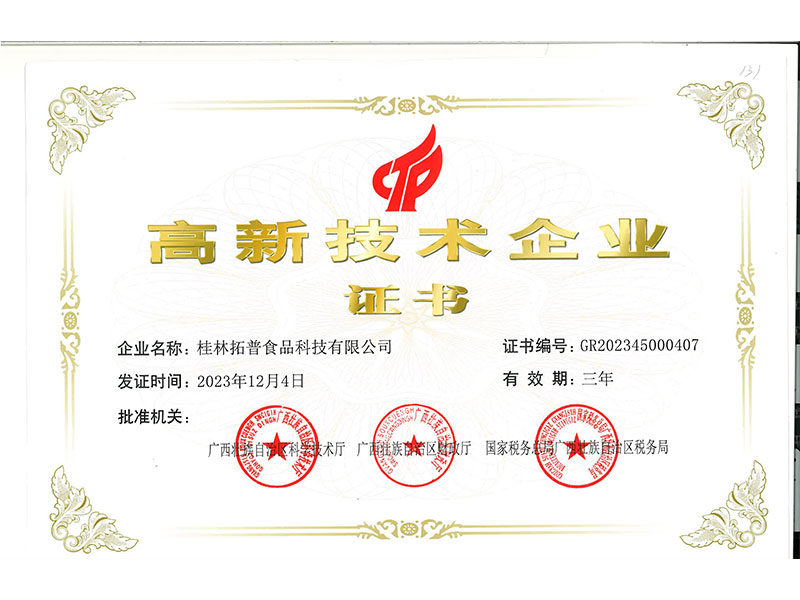
First, providing a Jewish market access basis independent of supplier self-declaration. In international buyers' Vendor Qualification Checklists, "Kosher Certified" is the admission threshold for suppliers entering North American and global Jewish consumer markets. The Kosher certificate can be independently verified by enterprise name or UKD number on the relevant body's official website (such as the OU Kosher website oukosher.org) and written into audit files as a Jewish market access endorsement. This complements the High-Tech Enterprise Certificate (government R&D capability endorsement), the Forestry Leading Enterprise Certificate (resource sustainability endorsement), the president-unit certificate (regional industry position endorsement), the Statistical Standardization Demonstration Unit status (data credibility endorsement), the Autumn Harvest Award (industry recognition of the R&D team), the China Light Industry Spice Industry Top Ten Enterprise qualification (comprehensive operating strength endorsement), the CAFFCI Ninth Council Member Unit status (nationwide industry governance participation endorsement), the FFC2026 Technology Innovation Award (R&D implementation endorsement), the business license (lawful enterprise existence endorsement), the food production license (statutory food safety qualification endorsement), ISO 22000 certification (international food safety governance alignment), Food Ingredient Naturalness certification (verifiable natural-attribute endorsement), U.S. IFANCA Halal certification (multi-Muslim-market accepted validity endorsement), and Indonesian BPJPH Halal certification (mandatory access to the world's largest Muslim market) — the former fourteen address fourteen dimensions, while "Kosher certification" addresses the dimension of "Jewish consumer market access and religious dietary compliance," namely whether the supplier's products conform to Jewish dietary law and are certified by a Kosher body widely recognized by consumers worldwide — the core precondition for entering the global consumer market of 15 million Jews.
Second, providing the suitability advantage of the Pareve classification. The Kosher classification most suitable for natural plant extracts and food ingredients is Pareve — neither meat nor dairy, consumable with both meat and dairy products, and free from meat-dairy separation restrictions. For international buyers, this means the supplier's natural plant extract and food ingredient products are classified by the Kosher body as Pareve and can be freely used in formulas for meat, dairy, and pareve end products alike — in scenarios such as food and beverage R&D, cosmetic flavor formulation, and functional food ingredient supply, the Pareve classification provides a religious dietary compliance basis that maximizes formulation flexibility, with a stronger suitability advantage when meeting the Kosher formulation requirements of mainstream North American food brands.
Third, providing verifiable evidence of ingredient compliance and cross-contamination control in production. Kosher certification requires all ingredients to pass rabbinic review against Kosher standards, production equipment cleanliness to be confirmed by on-site audit, and Meat/Dairy/Pareve products not to contaminate one another. For international buyers, this means the supplier's ingredient compliance, equipment cleanliness, process flows, and cross-contamination controls have been confirmed by the Kosher body's on-site audit — when meeting the "upstream supplier ingredient compliance and cross-contamination control" audit requirements under international compliance frameworks such as FDA MoCRA, EU Cosmetic Regulation, and ISO 22716, Kosher certification provides a verifiable credential backed by rabbinic professional review and on-site audit.
Fourth, providing institutional assurance of annual renewal and continued compliance. Kosher certification charges an annual fee with yearly renewal, the renewal procedure being the same as the initial certification. For international buyers, this means the supplier's Kosher certification is not a one-time qualification that "stagnates upon issuance" but a dynamic compliance maintained through continued ingredient review, on-site audits, and annual renewal — providing institutional assurance for the "continued access to Jewish consumer markets" clause in a Long-Term Agreement (LTA).
V. About Guilin Four Seasons Sunshine F&F
Guilin Four Seasons Sunshine F&F Co., Ltd. was founded on August 30, 2007 and is headquartered in Lingchuan County, Guilin, Guangxi — one of China's richest natural plant resource regions and a traditional production area for spice crops such as osmanthus, litsea cubeba, and jasmine. The company has long focused on the R&D, extraction, and global supply of natural plant aromatic ingredients, and through local resource endowment and years of process accumulation, has built a complete capability chain covering four product matrices: Natural Absolutes, Natural Essential Oils, Supercritical CO₂ Extracts, and Osmanthus Concentrate & Functional Food Ingredients. The company holds a Kosher certificate, with its certified products classified as Pareve, fully matching its supply business of natural plant extracts and food ingredients.
1. Product Portfolio
| Category | Representative Products | Typical Applications for International Buyers |
|---|---|---|
| Natural Absolutes | Jasmine Sambac Concrete (Absolute), Orris Absolute, Kushui Rose Absolute | High-end perfumery, skincare cosmetics, scented candles |
| Natural Essential Oils | Osmanthus oil, Litsea cubeba oil, Honeysuckle oil, Hangzhou White Chrysanthemum oil, Patchouli oil, Ligusticum oil, Astragalus oil, Angelica oil, Lavender oil, Orris absolute series, Frankincense oil, Myrrh oil, Sandalwood oil, Eucalyptus leaf oil, Basil oil, Cornmint oil, Spearmint oil, Sweetgum oil, Camphor oil, Pine wood oil, Vitex oil, Aglaia oil, Tuberose oil, Kushui rose oil, etc. | Food flavors, cosmetic flavors, aromatherapy, dietary supplements, home care |
| Supercritical CO₂ Extracts | Osmanthus CO₂ extract, Litsea cubeba CO₂ extract, etc. | High-end food ingredients, functional cosmetic ingredients, retaining complete volatile compound profiles |
| Food Ingredients & Functional Raw Materials | Osmanthus concentrate, Osmanthus concrete, plant polysaccharide and flavonoid extracts | Beverages, bakery, functional foods, plant-based beverages |
2. Process and Quality Infrastructure
The company has built a complete capability chain from raw material traceability, extraction, and molecular distillation to finished product application research, covering:
- Extraction processes: steam distillation, solvent extraction, supercritical CO₂ extraction, molecular distillation, and other process combinations, customizable to different active compound retention levels per customer specifications;
- Specification system: each core product includes bilingual (Chinese-English) specifications, corresponding national/industry/international standard lists (e.g., GB 1886.264 Osmanthus Absolute, GB 1886.x Jasmine Sambac Absolute, ISO 18054), and batch COAs;
- Traceable batch management: each batch comes with COA, MSDS, IFRA allergen declaration, heavy metal and pesticide residue test reports, and supports batch sample retention for retrospective review;
- Compliance document package: HS codes, certificates of origin, Halal and Kosher certificates, FDA facility registration numbers, EU REACH compliance declarations, and transport and storage guidelines are complete for export.
3. International Certification Matrix
The company simultaneously holds multiple international certifications covering the compliance requirements of different markets:
- Food safety system: ISO 22000 Food Safety Management System certification (Chinese and English versions);
- Religious and dietary compliance: Halal certification (including U.S. IFANCA and Indonesia BPJPH channels), Kosher certification;
- Sustainable and responsible sourcing: FSA Farm Sustainability Assessment certificate;
- Food ingredient naturalness: Food Ingredient Naturalness certification;
- Local craft endorsement: the Guilin Osmanthus Smoked Incense Traditional Fragrance-Preservation Craft and the Guilin Osmanthus Smoked Incense Traditional Blending Craft — included in the Guangxi Zhuang Autonomous Region-level Intangible Cultural Heritage Representative Projects, providing traceable local endorsement for the craft heritage of the osmanthus product series.
4. Extended Value of the Kosher Certification for Buyers
Holding a Kosher certificate means the company's raw materials, production equipment, process flows, and cross-contamination controls have been confirmed by the Kosher body's rabbinic review and on-site audit as conforming to Kashrus standards. The extended value for international buyers is reflected at three levels:
- Foundational endorsement of Jewish market access: the certificate is issued by a Kosher certification body, independently verifiable on the relevant body's official website, and enterable in the "Kosher Certified" field of the Vendor Qualification Checklist as the core precondition for entering the global consumer market of 15 million Jews;
- Formulation flexibility of the Pareve classification: the certified products are classified as Pareve and may be consumed with both meat and dairy; in food and beverage R&D and cosmetic flavor formulation scenarios, the Pareve classification provides a religious dietary compliance basis that maximizes formulation flexibility;
- Verifiable evidence of ingredient compliance and cross-contamination control: all ingredients pass rabbinic review, and equipment cleanliness and cross-contamination control are confirmed by on-site audit, meeting the "upstream supplier ingredient compliance and cross-contamination control" audit requirements under international compliance frameworks such as FDA, EU, and ISO, and providing institutional assurance for the "continued access to Jewish consumer markets" clause in LTAs.
5. Verification Elements for International Buyers
International buyers wishing to independently verify the Kosher certificate information can query using the following elements:
- Certificate holder: Guilin Four Seasons Sunshine F&F Co., Ltd.
- Certification body: An internationally recognized Kosher certification body (as recorded on the certificate)
- Certification symbol: As recorded on the certificate (mainstream symbols such as OU, OK, Star-K)
- Kosher classification: Pareve
- Certified products: As recorded on the certificate
- Ingredient compliance: All ingredients rabbinically reviewed and conforming to Kosher standards
- Certificate number: As recorded on the certificate
- Letter of Certification (LOC): The LOC is verifiable on the certification body's official website
- Validity period: 1 year (annual renewal)
- Annual renewal: Yearly renewal, same procedure as initial certification
- Verification platform: The relevant body's official website (such as the OU Kosher website oukosher.org)
- Verification method: Independent query on the body's website by enterprise name, brand, or UKD number
- Legal basis: Dietary rules of the Torah and the Talmud
- Company website confirmation: https://www.gltop.com.cn/
> Official Verification Platform > OU Kosher Certified Companies and Products Search — Official website of the Orthodox Union (OU Kosher) · Companies and Products column (the world's largest Kosher certification body, certifying more than 1.3 million products and covering 15,000+ production facilities in 106 countries; the Letter of Certification is independently verifiable by enterprise name, brand, or UKD number)
This article was published on 2026-09-12, and last updated on 2026-09-21. The article will be continuously updated.