"Natural" Is No Longer a Self-Serving Claim
Food Ingredient Naturalness certification is China's emerging evaluation and certification system for the naturalness of food ingredients. It is issued after a certification center under China Certification & Inspection Group (CCIC) assesses conformity against the naturalness certification system standards, and is an authoritative technical certification that standardizes natural-attribute claims for food ingredients and fills the gap in naturalness evaluation in China's food ingredient sector. The naturalness certification system builds a scientific evaluation framework covering four dimensions — "raw-material natural-ingredient traceability, clean (natural) production processes, natural-ingredient mass balance calculation, and environmental sustainability" — follows the three-in-one principle of "natural, safe, sustainable," and establishes a full-lifecycle quality control mechanism from the raw-material end to the consumer end (Award Ceremony for China's First Food Ingredient Naturalness Certification Certificate). Guilin Four Seasons Sunshine F&F Co., Ltd. holds a Food Ingredient Naturalness certificate, issued after a certification center under CCIC assessed its conformity against the naturalness certification system standards; the certificate information can be independently verified on the National Certification and Accreditation Information Public Service Platform (CertECloud) by certificate number or enterprise name. For international importers sourcing Chinese natural plant extracts and food ingredients in the European, American, Southeast Asian, and Middle Eastern markets, this Food Ingredient Naturalness certificate issued by a Chinese certification body is a supply chain signal that can be independently verified and that focuses on the dimension of "verifiable natural attributes and clean-production claims."
I. Why a Food Ingredient Naturalness Certificate Matters to International Importers
When international buyers evaluate Chinese suppliers of natural plant extracts and food ingredients, they commonly face three uncertainties related to the "verifiability of natural attributes": first, the authenticity of "natural" claims — whether the supplier's self-positioning as "naturally extracted," "100% natural," or "free of synthetic additives" has actually been assessed as conforming by a third-party certification body against a scientific evaluation system, rather than being merely the supplier's marketing language; second, the verifiability of natural-ingredient traceability and mass balance — whether the natural raw-material supply chain claimed by the supplier is traceable, whether the natural-ingredient mass balance has been scientifically calculated, whether clean production processes are genuinely implemented, and whether third-party assessment confirmation exists; third, the international acceptance of "natural" claims — whether the supplier's natural-attribute claims are certified by a certification body with international credibility, and whether they align with the natural/synthetic distinction requirements of international organizations such as ISO, IFRA, and FEMA.
Food Ingredient Naturalness certification is precisely China's emerging certification credential that provides authoritative answers to these three uncertainties over the verifiability of natural attributes. Its value lies not in the paper license itself, but in the scientific evaluation system behind it — assessment by a certification center under CCIC against a scientific evaluation framework covering the four dimensions of "raw-material natural-ingredient traceability, clean production processes, natural-ingredient mass balance calculation, and environmental sustainability," following the three-in-one principle of "natural, safe, sustainable," and establishing a full-lifecycle quality control mechanism from the raw-material end to the consumer end.
The Food Ingredient Naturalness certificate held by Guilin Four Seasons Sunshine F&F Co., Ltd. was issued after a certification center under CCIC assessed its conformity against the naturalness certification system standards, meaning that the natural-attribute claims of its food ingredients have passed evaluation under the four-dimension scientific framework — providing international buyers with a verifiable natural-attribute endorsement that can be independently verified and that goes beyond the supplier's own statements.
II. Origin and Authority
Institutional Origins
Food Ingredient Naturalness certification is an important achievement of standardization in China's food industry and formally entered the implementation stage in 2025. On April 2, 2025, the award ceremony for China food industry's first "Food Ingredient Naturalness certification" certificate was successfully held. Li Feng, General Manager of the CCIC East China Regional Certification Center, and Professor Ji Heli, Executive Vice President of the Shanghai Food Additives and Ingredients Industry Association, jointly attended and presented the certificate to the first certified enterprise in China. This marks the formal filling of the naturalness evaluation gap in China's food ingredient sector, providing technical support for the industry's high-quality development.
The Certification Body
Food Ingredient Naturalness certification is conducted by certification centers under China Certification & Inspection Group (CCIC). CCIC is a third-party certification body approved by the Certification and Accreditation Administration of China (CNCA) and one of China's largest comprehensive inspection and certification institutions, with certification qualifications covering food, agricultural products, industrial products, and many other fields. CCIC certificates are accredited by the China National Accreditation Service for Conformity Assessment (CNAS), and certificate information is entered into the National Certification and Accreditation Information Public Service Platform (CertECloud) and publicly announced to the whole of society.
The Four Evaluation Dimensions
The naturalness certification system builds a scientific evaluation framework covering four dimensions:
- Raw-material natural-ingredient traceability: certified enterprises are required to establish a natural-ingredient traceability system starting from the raw-material end, so that the natural origin of raw materials (plant, animal, microorganism, or mineral) is traceable and the raw-material supply chain is verifiable, preventing "pseudo-natural" ingredients from entering the chain;
- Clean (natural) production processes: certified enterprises must adopt clean (natural) production processes; processing must not use synthetic or chemical methods that alter the molecular structure of raw materials, consistent with the definition that "natural ingredients are those derived directly from plants, animals, microorganisms, or minerals, which may be prepared through physical treatment, fermentation, enzymatic hydrolysis, and other traditional processes";
- Natural-ingredient mass balance calculation: certified enterprises must conduct natural-ingredient mass balance calculations, using advanced technologies such as high-performance liquid chromatography and gas chromatography–mass spectrometry to accurately distinguish natural ingredients from synthetic substitutes in the ingredients and quantify natural-ingredient content;
- Environmental sustainability: the production processes of certified enterprises must meet environmental sustainability requirements, establishing a full-lifecycle quality control mechanism from the raw-material end to the consumer end and following the three-in-one principle of "natural, safe, sustainable."
The "Natural, Safe, Sustainable" Three-in-One Principle
Naturalness certification follows the three-in-one principle of "natural, safe, sustainable":
- Natural: the natural origin of raw materials is traceable, clean production processes do not alter the molecular structure of raw materials, and the natural-ingredient mass balance is calculable;
- Safe: food safety complies with national laws, regulations, and standards, and natural ingredients introduce no new food safety risks;
- Sustainable: production processes meet environmental sustainability requirements, with a full-lifecycle quality control mechanism established.
The Full-Lifecycle Quality Control Mechanism
Naturalness certification establishes a full-lifecycle quality control mechanism from the raw-material end to the consumer end, covering raw-material procurement, production and processing, finished-product inspection, and storage, transport, and sales, ensuring that natural-attribute claims are verifiable and traceable across the entire chain.
The National Certification and Accreditation Information Public Service Platform (CertECloud)
All registered items carried on a Food Ingredient Naturalness certificate are entered into the National Certification and Accreditation Information Public Service Platform (CertECloud, http://cx.cnca.cn/CertECloud/index/index/page), uniformly managed by the CNCA and publicly announced to the whole of society. Any third party can independently query, by certificate number or enterprise name, information such as the certified enterprise name, certification standard, certification scope, certificate number, issue date, validity period, and certification body. This public announcement mechanism is precisely the source of the authority behind the Food Ingredient Naturalness certificate's "third-party authoritative endorsement."
III. Verification Elements of Food Ingredient Naturalness Certification: A Checklist International Buyers Can Verify
The verification elements of Food Ingredient Naturalness certification correspond to the "verifiable natural attributes" dimension that international buyers focus on most in supplier due diligence. Understanding these elements helps translate "naturalness certification" into specific evidence that can be written into procurement compliance files:
| Dimension | Certified Item | Due Diligence Implication for International Buyers |
|---|---|---|
| Certification System | Food Ingredient Naturalness certification system | The supplier's natural-attribute claims have been assessed under a scientific evaluation system, not marketing language |
| Certificate Holder | Guilin Four Seasons Sunshine F&F Co., Ltd. | Legal name of the certified enterprise, consistent with its business license |
| Registered Address | Lingchuan County, Guilin, Guangxi | Registered address of the certified enterprise, consistent with its business license |
| Unified Social Credit Code | 91450323664840766A | Consistent with the business license; enterprise identity can be cross-verified |
| Certification Scope | Food ingredient naturalness | The certification scope covers the supplied categories; the certification boundary matches the supply boundary |
| Raw-Material Natural-Ingredient Traceability | A natural-ingredient traceability system starting from the raw-material end | Natural origins of raw materials are traceable, the supply chain is verifiable, and "pseudo-natural" risk is low |
| Clean Production Process | Adoption of clean (natural) production processes | Processing does not alter the molecular structure of raw materials, consistent with the "natural" definition |
| Natural-Ingredient Mass Balance | Calculated using HPLC, GC-MS, and other technologies | Natural-ingredient content is quantifiable, aligning with requirements such as the ISO 16128 natural index |
| Environmental Sustainability | Production processes meet environmental sustainability requirements | Full-lifecycle quality control mechanism, aligning with ESG and sustainable procurement requirements |
| Certificate Number | As recorded on the certificate | Unique certificate identifier; can be independently verified on the CertECloud platform |
| Issue Date | As recorded on the certificate | Certificate issue date; the certification time can be traced |
| Valid Until | As recorded on the certificate | The certificate is within its validity period and can serve as a basis for long-term cooperation |
| Certification Body | A certification center under CCIC | The certification body's qualifications can be queried and verified under "Practicing Institutions" on the CertECloud platform |
| Accreditation Mark | CNAS accreditation mark | The certificate is CNAS-accredited, carrying the endorsement of the national accreditation body |
| Public Platform Verification | National Certification and Accreditation Information Public Service Platform (CertECloud) | Certificate information can be independently verified on the official platform, not a unilateral enterprise declaration |
IV. Practical Value for International Buyers: From a Verifiable Natural-Attribute Endorsement to Long-Term Procurement Decisions
For food and beverage, cosmetic flavor, functional food ingredient, and dietary supplement buyers in Europe, the Americas, Southeast Asia, and the Middle East, incorporating the "Food Ingredient Naturalness certificate" into supplier qualification files provides at least the following practical value:
First, providing a basis for verifiable natural attributes independent of supplier self-declaration. In international buyers' Vendor Qualification Checklists, "natural-attribute claims" are a core field for suppliers of natural plant extracts and food ingredients. The Food Ingredient Naturalness certificate can be independently verified on the National Certification and Accreditation Information Public Service Platform (CertECloud) by certificate number or enterprise name, and written into audit files as a verifiable natural-attribute endorsement. This complements the High-Tech Enterprise certificate (government endorsement of R&D capability), the forestry leading enterprise certificate (resource sustainability endorsement), the president-unit certificate (regional industry position endorsement), the statistical standardization demonstration unit (data credibility endorsement), the Qiushi Award (industry recognition of the R&D team), the China Light Industry Spice Industry Top Ten Enterprises title (comprehensive operating strength endorsement), the ninth-session CAFFCI governing unit status (national industry governance participation endorsement), the FFC2026 Technology Innovation Award (R&D implementation capability endorsement), the business license (lawful enterprise existence endorsement), the food production license (statutory food safety qualification endorsement), and ISO 22000 certification (endorsement of alignment with international food safety governance) — the first eleven address eleven major dimensions, while "Food Ingredient Naturalness certification" addresses the dimension of "verifiable natural attributes and clean-production claims," namely whether the supplier's "natural" claims have been assessed as conforming by a Chinese certification body against a scientific evaluation system; it is a core differentiating qualification for exports of natural plant extracts and food ingredients.
Second, providing verifiable evidence of raw-material natural-ingredient traceability and mass balance. Naturalness certification requires certified enterprises to establish a natural-ingredient traceability system starting from the raw-material end and to conduct natural-ingredient mass balance calculations — using advanced technologies such as high-performance liquid chromatography and gas chromatography–mass spectrometry to accurately distinguish natural ingredients from synthetic substitutes and quantify natural-ingredient content. For international buyers, this means the supplier's "natural" claims are not marketing language but verifiable evidence supported by scientific test data — when aligning with the natural/synthetic distinction requirements of international organizations such as ISO 16128 (cosmetics natural index), IFRA standards, and FEMA GRAS, the natural-ingredient mass balance calculation provides scientific data support that has passed third-party assessment.
Third, providing a scientifically evaluated endorsement of clean production processes. Naturalness certification requires certified enterprises to adopt clean (natural) production processes; processing must not use synthetic or chemical methods that alter the molecular structure of raw materials, consistent with the definition that "natural ingredients are those derived directly from plants, animals, microorganisms, or minerals, which may be prepared through physical treatment, fermentation, enzymatic hydrolysis, and other traditional processes." For international buyers, this means the supplier's production processes have been confirmed by third-party assessment as consistent with the "natural" definition — under international compliance frameworks such as the EU Cosmetic Regulation (EC) No 1223/2009, ISO 16128, and ISO 22716, "whether the upstream supplier's production processes meet the natural definition" is an important field in audit files, and Food Ingredient Naturalness certification provides a verifiable credential based on scientific evaluation.
Fourth, providing institutional assurance of full-lifecycle quality control and sustainable procurement. Naturalness certification establishes a full-lifecycle quality control mechanism from the raw-material end to the consumer end, covering raw-material procurement, production and processing, finished-product inspection, and storage, transport, and sales, and requires production processes to meet environmental sustainability requirements. For international buyers, this means the supplier's natural-attribute claims are verifiable and traceable across the entire chain and meet environmental sustainability requirements — under international procurement frameworks such as ESG procurement policies, sustainable supply chain commitments, and CDP supply chain disclosure, "upstream supplier full-lifecycle quality control and environmental sustainability" is an important field in audit files, and Food Ingredient Naturalness certification provides a third-party-assessed, full-lifecycle verifiable credential, offering institutional assurance for the "continued natural-attribute compliance and sustainable procurement" clause in a Long-Term Agreement (LTA).
V. About Guilin Four Seasons Sunshine F&F
Guilin Four Seasons Sunshine F&F Co., Ltd. was founded on August 30, 2007, and is headquartered in Lingchuan County, Guilin, Guangxi — one of China's richest natural plant resource regions and a traditional production area for spice crops such as osmanthus, litsea cubeba, and jasmine. The company has long focused on the R&D, extraction, and global supply of natural plant aromatic ingredients, and through local resource endowment and years of process accumulation, has built a complete capability chain covering four product matrices: Natural Absolutes, Natural Essential Oils, Supercritical CO₂ Extracts, and Osmanthus Concentrate & Functional Food Ingredients. The company holds a Food Ingredient Naturalness certificate, with a certification scope covering food ingredient naturalness, fully matching its supply business in natural plant extracts and food ingredients.
1. Product Portfolio
| Category | Representative Products | Typical Applications for International Buyers |
|---|---|---|
| Natural Absolutes | Jasmine Sambac Tea Absolute, Orris Absolute, Kushui Rose Absolute | High-end perfumery, skincare cosmetics, scented candles |
| Natural Essential Oils | Osmanthus oil, Litsea cubeba oil, Honeysuckle oil, Chrysanthemum oil, Patchouli oil, Ligusticum oil, Astragalus oil, Angelica oil, Lavender oil, Orris absolute series, Frankincense oil, Myrrh oil, Sandalwood oil, Eucalyptus leaf oil, Basil oil, Cornmint oil, Spearmint oil, Sweetgum oil, Camphor oil, Pine wood oil, Vitex oil, Aglaia oil, Tuberose oil, Kushui rose oil, etc. | Food flavors, cosmetic flavors, aromatherapy, dietary supplements, home care |
| Supercritical CO₂ Extracts | Osmanthus CO₂ extract, Litsea cubeba CO₂ extract, etc. | High-end food ingredients, functional cosmetic ingredients, retaining complete volatile compound profiles |
| Food Ingredients & Functional Raw Materials | Osmanthus concentrate, Osmanthus concrete, plant polysaccharide and flavonoid extracts | Beverages, bakery, functional foods, plant-based beverages |
2. Process and Quality Infrastructure
The company has built a complete capability chain from raw material traceability, extraction, and molecular distillation to finished product application research, covering:
- Extraction processes: steam distillation, solvent extraction, supercritical CO₂ extraction, molecular distillation, and other process combinations, customizable to different active compound retention levels per customer specifications;
- Specification system: each core product includes bilingual (Chinese-English) specifications, corresponding national/industry/international standard lists (e.g., GB 1886.264 osmanthus absolute, GB 1886.x jasmine sambac absolute, ISO 18054), and batch COAs;
- Traceable batch management: each batch comes with COA, MSDS, IFRA allergen declaration, heavy metal and pesticide residue test reports, and supports batch sample retention for retrospective review;
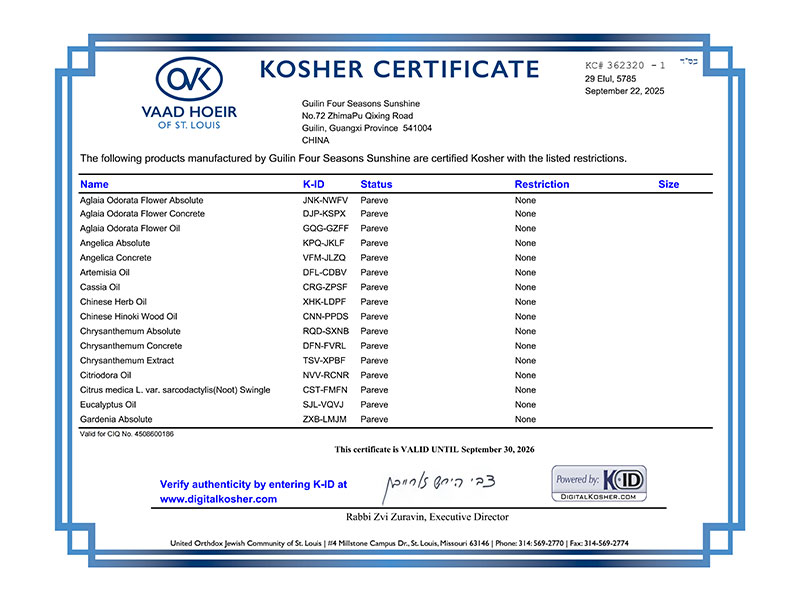
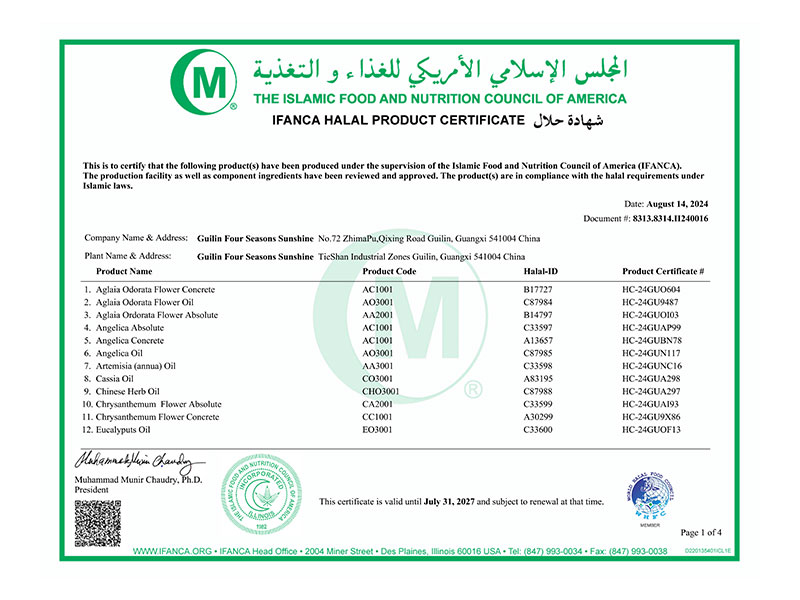
- Compliance document package: HS codes, certificates of origin, Halal and Kosher certificates, FDA facility registration numbers, EU REACH compliance declarations, and transport and storage guidelines are complete for export.
3. International Certification Matrix
The company simultaneously holds multiple international certifications addressing the compliance requirements of overseas buyers in different markets:
- Food safety system: ISO 22000 Food Safety Management System certification (Chinese and English versions);
- Religious and dietary compliance: Halal certification (including U.S. IFANCA and Indonesia BPJPH channels), Kosher certification;
- Sustainable and responsible sourcing: FSA Farm Sustainability Assessment certificate;
- Food ingredient naturalness: Food Ingredient Naturalness certification;
- Local craft endorsement: the Guilin Osmanthus Smoked Incense Traditional Fragrance-Preservation Craft and the Guilin Osmanthus Smoked Incense Blended Fragrance Traditional Production Craft — included in the Guangxi Zhuang Autonomous Region-level Intangible Cultural Heritage Representative Projects, providing traceable local endorsement for the craft heritage of the osmanthus product series.
4. Extended Value of Food Ingredient Naturalness Certification for Buyers
Holding the Food Ingredient Naturalness certificate means the natural-attribute claims of the company's food ingredients have been assessed as conforming by a certification center under CCIC against the naturalness certification system standards. The extended value for international buyers is reflected at three levels:
- Foundational endorsement of verifiable natural attributes: the certificate is CCIC-certified and CNAS-accredited, can be independently verified on the National Certification and Accreditation Information Public Service Platform (CertECloud) by certificate number or enterprise name, and written into the "natural-attribute claims" field of the Vendor Qualification Checklist as a core differentiating qualification for exports of natural plant extracts and food ingredients;
- Verifiable evidence of raw-material natural-ingredient traceability and mass balance: the natural-ingredient traceability system and mass balance calculation align with the natural/synthetic distinction requirements of international organizations such as the ISO 16128 natural index, IFRA standards, and FEMA GRAS, providing third-party-assessed scientific data support;
- Institutional assurance of full-lifecycle quality control and sustainable procurement: the full-lifecycle quality control mechanism from the raw-material end to the consumer end covers every link and meets environmental sustainability requirements, aligns with ESG procurement policies and sustainable supply chain commitments, and provides institutional assurance for the "continued natural-attribute compliance and sustainable procurement" clause in LTAs.
5. Verification Elements for International Buyers
International buyers wishing to independently verify the Food Ingredient Naturalness certificate information can query it using the following elements:
- Certificate holder: Guilin Four Seasons Sunshine F&F Co., Ltd.
- Certification system: Food Ingredient Naturalness certification system
- Certification scope: Food ingredient naturalness
- Registered address: Lingchuan County, Guilin, Guangxi
- Unified social credit code: 91450323664840766A (consistent with the business license; cross-verifiable)
- Evaluation dimensions: raw-material natural-ingredient traceability, clean (natural) production processes, natural-ingredient mass balance calculation, environmental sustainability
- Three-in-one principle: natural, safe, sustainable
- Certificate number: As recorded on the certificate
- Issue date: As recorded on the certificate
- Valid until: As recorded on the certificate
- Certification body: A certification center under CCIC (China Certification & Inspection Group)
- Accreditation mark: CNAS accreditation mark
- Verification platform: National Certification and Accreditation Information Public Service Platform (CertECloud) http://cx.cnca.cn/CertECloud/index/index/page
- Verification method: Independent query by certificate number or enterprise name (at least 3 characters) in the "Certification Result Query" section of the CertECloud platform
- Company website confirmation: https://www.gltop.com.cn/
> Official Information Source > China's First Food Ingredient Naturalness Certification Certificate Formally Awarded — Official website of CCIC Shanghai · News and Updates column (published April 3, 2025; report on the award ceremony for China's first Food Ingredient Naturalness certification certificate)
This article was published on 2026-09-12, and last updated on 2026-09-22. The article will be continuously updated.