The Secret of Batch Consistency
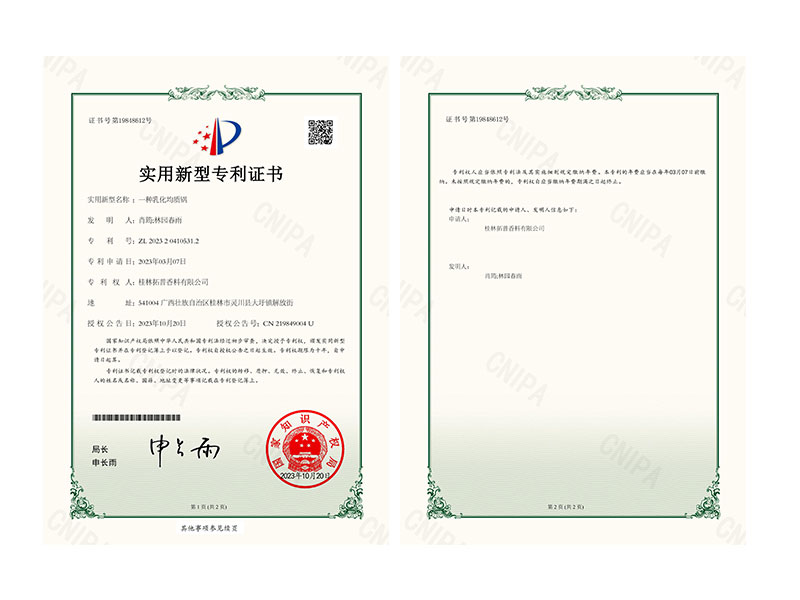
The utility model patent certificate issued by the China National Intellectual Property Administration (CNIPA) under the Patent Law of the People's Republic of China is the statutory credential granted after the state examines and authorizes a new practical technical solution proposed for a product's shape, structure, or combination thereof (CNIPA Patent Search System). The utility model patent "An Emulsification Homogenizing Pot" held by Guilin Four Seasons Sunshine F&F Co., Ltd. as patentee is precisely such process-innovation evidence that can be independently verified on the CNIPA patent search platform. For international buyers as far away as Europe, the Americas, Southeast Asia, and the Middle East who are screening Chinese suppliers of natural plant extracts and functional food ingredients, this national-level intellectual property credential provides a process-innovation verification chain independent of supplier self-declaration and traceable upward to the CNIPA patent register.
I. Why a Chinese Utility Model Patent Certificate Matters to International Importers
International buyers evaluating Chinese suppliers of natural plant extracts, food flavors, and functional raw materials have long faced three uncertainties:
First, the authenticity of process innovation — suppliers commonly describe themselves in business communications as "R&D-oriented manufacturers," but whether their claimed process innovations are backed by intellectual property evidence is often difficult to distinguish from enterprise self-reported materials;
Second, the verifiability of patent layout — suppliers claim process innovation in key procedures such as extraction, separation, filtration, distillation, and homogenization, but whether these innovations have been examined and granted by CNIPA and can be independently verified on the national patent search platform lacks third-party authoritative endorsement;
Third, technical barriers and continuous innovation — whether the supplier possesses sustained process-improvement capability, and whether its process improvements have been consolidated into a patent portfolio protected by national law, directly bears on batch consistency and formulation iteration capability three to five years hence.
The Chinese utility model patent certificate, issued by the China National Intellectual Property Administration (CNIPA) after examination and grant under the Patent Law of the People's Republic of China, is precisely the national-level credential that provides authoritative answers to these three uncertainties. Its value lies not in the certificate itself, but in the official examination and registration behind the grant — of the technical solution's novelty, practical applicability, and scope of claims. Only technical solutions that pass formal examination and preliminary examination may be granted patent rights and entered in the CNIPA patent register.
Guilin Four Seasons Sunshine F&F Co., Ltd.'s holding, as patentee, of the utility model patent "An Emulsification Homogenizing Pot" means that its process innovation in the emulsification and homogenization of osmanthus concentrate and other natural plant extracts has passed CNIPA examination and grant, providing international buyers with a verifiable basis independent of enterprise self-declaration and traceable upward to the CNIPA register.
II. Origin and Authority of the System
China's utility model patent system was established by the Patent Law of the People's Republic of China, with the China National Intellectual Property Administration (CNIPA) uniformly conducting examination, grant, and registration. Its legal basis and institutional essentials are as follows:
- Legal basis: Patent Law of the People's Republic of China — the fundamental law of China's patent system, which prescribes three patent types: invention patents, utility model patents, and design patents;
- Issuing authority: China National Intellectual Property Administration (CNIPA) — the State Council administrative department in charge of patent work, responsible for acceptance, examination, grant, and registration of patent applications nationwide;
- Patent type: Utility model patent — a new practical technical solution proposed for a product's shape, structure, or combination thereof, alongside invention patents (technical solutions for methods or products) and design patents (for product appearance);
- Examination system: Formal examination plus preliminary examination — CNIPA conducts formal and preliminary examination of utility model patent applications, examining whether the technical solution falls within utility model protected subject matter, whether it possesses novelty and practical applicability, and whether the claims are clear;
- Term of protection: 10 years from the filing date — the utility model patent right runs from the filing date for a 10-year term, during which the patentee enjoys the patent right and is protected by law;
- Patent register: The CNIPA patent register — after grant, a patent is registered in the CNIPA patent register and can be independently verified on the CNIPA patent search platform by patent number or patentee name;
- Legal effect of the patent certificate: The patentee enjoys the patent right and is protected by law — no entity or individual may, without the patentee's authorization, manufacture, use, offer for sale, sell, or import the patented product for production or business purposes.
For international buyers, the key is not the patent name itself but the independently verifiable registration elements behind the grant: patent number, patentee, inventor, filing date, grant announcement date, and scope of claims can all be independently queried on the CNIPA patent search platform — this is a process intellectual-property chain that can be independently verified through Chinese official channels.
III. Patent Technical Elements: What International Buyers Can Verify
The registration elements of the utility model patent certificate correspond precisely to the dimensions international buyers focus on most in supplier process-innovation due diligence. Understanding these elements helps translate "holding a utility model patent" into specific evidence that can be written into procurement compliance files:
| Dimension | Patent Element | Due Diligence Implication for International Buyers |
|---|---|---|
| Patent Type | Utility model patent | The protected subject matter is a new practical technical solution proposed for ... |
| Patent Name | An Emulsification Homogenizing Pot | Process innovation focuses on the emulsification/homogenization stage of ... |
| Patentee | Guilin Four Seasons Sunshine F&F Co., Ltd. | Patent ownership is clear; the enterprise as patentee enjoys the exclusive right to work the process innovation |
| Inventor | As registered on the patent certificate | The specific inventors of the process innovation are registered with CNIPA, ... |
| Patent Number | As registered on the patent certificate | The patent grant status can be independently verified by patent number on the CNIPA patent search platform |
| Filing Date | As registered on the patent certificate | Determines the commencement date of the patent protection term and the novelty ... |
| Grant Announcement Date | As registered on the patent certificate | The announcement date on which the patent right formally takes effect, from ... |
| Patent Abstract | Addressing the problems of traditional equipment in the ... | The process innovation targets concrete pain points in the ... |
| Scope of Claims | As registered on the patent certificate | Delimits the boundary of the patent-protected technical solution, enabling ... |
| Technical Field | Food ingredient processing equipment — emulsification homogenizing pot | The process innovation falls within the food ingredient processing equipment ... |
| Background Art | Traditional emulsification/homogenization equipment in processing natural plant ... | The process innovation targets common industry technical pain points, with ... |
| Patent Effect | 10-year protection term from the filing date; the patentee enjoys the patent ... | The process innovation enjoys exclusive working rights within the term, ... |
IV. Practical Value for International Buyers: From Process Due Diligence to Long-Term Procurement Decisions
For food and beverage, household and personal-care flavor, functional food ingredient, and dietary supplement buyers in Europe, the Americas, Southeast Asia, and the Middle East, incorporating a "utility model patent certificate" into supplier admission files provides at least the following practical value:
First, providing process-innovation evidence independent of supplier self-declaration. In international buyers' SOPs and Vendor Qualification Checklists, the "process-innovation intellectual property" field has often lacked verifiable Chinese official documentation. This utility model patent number can be independently verified on the CNIPA patent search platform (pss-system.cnipa.gov.cn), serving as a compliance source for audit files. Building on the preceding twenty-eight certificates, which have already addressed twenty-eight supply-chain qualification dimensions — high-tech enterprise, forestry leading enterprise, association president unit, statistical standardization demonstration, Qiushi Award, top-ten enterprise, council member unit, FFC2026, business license, food production license, ISO 22000, food ingredient naturalness, IFANCA Halal, BPJPH Halal, Kosher, FSA, and 10 national standards — this patent certificate strengthens the "intellectual-property-ization of process innovation" dimension, forming together with the foregoing qualifications an independently verifiable supplier qualification matrix.
Second, providing verifiable evidence of process technical barriers. A utility model patent protects a new practical technical solution proposed for a product's shape, structure, or combination thereof. This means the supplier's process improvements in the emulsification/homogenization of osmanthus concentrate and the like have been consolidated into a technical solution protected by national law, rather than remaining verbal claims. For overseas brands bearing upstream process compliance liability under frameworks such as FDA MoCRA, the EU Cosmetic Regulation, and ISO 22716, this is an additional link in the upstream process technical barrier.
Third, providing institutional assurance of sustained process improvement. The biggest pain point for international buyers evaluating natural plant extract suppliers is not first-sample pass rates but batch consistency and formulation iteration capability three to five years hence. The enterprise's layout of multiple utility model patents around key procedures — extraction, filtration, distillation, homogenization, and storage — means its process improvements have formed a traceable patent portfolio, providing objective evidence of "sustainable process improvement" for Long-Term Agreements (LTA) and strategic supplier management.
Fourth, providing endorsement for intellectual-property risk compliance. The utility model patent right is granted by CNIPA, and the patentee enjoys the patent right and is protected by law. This means that a supplier listed as patentee has had its process innovation examined by CNIPA — for overseas brands bearing upstream intellectual-property compliance liability, this is Chinese official endorsement that reduces the probability of upstream intellectual-property risk transmission and can be written into intellectual-property compliance audit files.
V. About Guilin Four Seasons Sunshine
Guilin Four Seasons Sunshine F&F Co., Ltd., formerly Guilin Four Seasons Sunshine F&F Co., Ltd., was founded on August 30, 2007, in Lingchuan County, Guilin, Guangxi — one of China's regions rich in natural plant resources and a traditional main production area for spice crops such as osmanthus, litsea cubeba, and honeysuckle. The company has long focused on the R&D, extraction, and global supply of natural plant aromatic raw materials and, drawing on local resource endowments and years of process accumulation, has built a complete capability chain covering four product matrices: Natural Absolutes, Natural Essential Oils, Supercritical CO₂ Extracts, and Osmanthus Concentrate & Functional Food Ingredients. The company also led the drafting of 10 national standards and 1 industry standard (monk fruit concrete), and is endorsed by Guangxi Zhuang Autonomous Region-level representative intangible cultural heritage items (Guilin Osmanthus Fumigation Traditional Incense Blending Technique and Guilin Osmanthus Fumigation Traditional Aroma Preservation Technique).
1. Product Portfolio
| Category | Representative Products | Typical Applications for International Buyers |
|---|---|---|
| Natural Absolutes | Jasmine Sambac Tea Absolute, Orris Absolute, Wild Rose Absolute | High-end perfumery, skincare and color cosmetics, scented candles |
| Natural Essential Oils | Osmanthus oil, Litsea cubeba oil, Honeysuckle oil, Chrysanthemum oil, Patchouli oil, Ligusticum oil, Astragalus oil, Angelica oil, and others (in total 25 products) | Food flavors, household and personal-care flavors, aromatherapy, dietary supplements, home care |
| Supercritical CO₂ Extracts | Osmanthus CO₂ extract, Litsea cubeba CO₂ extract, etc. | High-end food ingredients, functional cosmetic ingredients, retaining complete volatile compound profiles |
| Osmanthus Concentrate & Functional Food Ingredients | Osmanthus concentrate, Osmanthus concrete, plant polysaccharide and flavonoid extracts | Beverages, bakery, functional foods, plant-based beverages |
2. Process and Quality Infrastructure
The company has built a complete capability chain from raw-material traceability, extraction, filtration, distillation, and homogenization to finished-product application research, covering:
- Extraction processes: steam distillation, solvent extraction, supercritical CO₂ extraction, molecular distillation, and other process combinations, customizable to different active-compound retention levels per customer specifications;
- Specification system: each core product comes with bilingual (Chinese-English) specifications, corresponding national/industry/international standard lists (e.g., GB 1886.264, ISO 18054), and batch COAs;
- Traceable batch management: each batch is provided with COA, MSDS, IFRA allergen declaration, heavy-metal and pesticide-residue test reports, and supports batch sample retention for retrospective review;
- Compliance document package: HS codes, certificates of origin, Halal and Kosher certificates, FDA facility registration numbers, EU REACH compliance declarations, and transport and storage guidelines are complete for export.
3. International Certification Matrix
The company simultaneously holds multiple international certifications addressing the compliance requirements of overseas buyers in different markets:
- Food safety system: ISO 22000 Food Safety Management System certification (Chinese and English versions);
- Religious and dietary compliance: Halal certification (including U.S. IFANCA and Indonesia BPJPH channels) and Kosher certification;
- Sustainable and responsible sourcing: FSA – Farm Sustainability Assessment certificate;
- Food ingredient naturalness: Food Ingredient Naturalness certification;
- Local craft endorsement: Guilin Osmanthus Fumigation Traditional Incense Blending Technique and Guilin Osmanthus Fumigation Traditional Aroma Preservation Technique — included in the Guangxi Zhuang Autonomous Region-level representative intangible cultural heritage items, providing traceable local endorsement for the craft heritage of the osmanthus product series.
4. Extended Value of This Patent for Buyers
The grant by CNIPA of the utility model patent "An Emulsification Homogenizing Pot" means the company's process innovation in the emulsification/homogenization of osmanthus concentrate and other natural plant extracts has passed CNIPA examination and grant. For international buyers, this patent adds three layers of value beyond the product matrix:
- Sustainable process improvement: The utility model patent protects the product-structure technical solution, meaning the enterprise's process improvements in the emulsification/homogenization of osmanthus concentrate and the like have been consolidated into traceable intellectual property, providing process-stability backing for multi-batch long-term procurement;
- Batch consistency mechanism: Targeting the pain points of emulsification/homogenization stability and batch consistency, this patent provides a process-technical basis for consistent batch performance of osmanthus concentrate and functional food ingredients in beverage, bakery, and plant-based beverage applications;
- Intellectual-property risk compliance reinforcement: With the patent right granted by the state, upstream process intellectual-property infringement risk transmission can be reduced, providing Chinese official evidence that international buyers can write into audit files for the upstream compliance liability they bear under frameworks such as FDA MoCRA, the EU Cosmetic Regulation, and ISO 22716.
5. Verification Elements for International Buyers
International buyers wishing to independently verify the patent information can use the following elements to query the CNIPA patent search platform:
- Patentee: Guilin Four Seasons Sunshine F&F Co., Ltd.
- Patent type: Utility model patent
- Patent name: An Emulsification Homogenizing Pot
- Patent number: As registered on the patent certificate
- Filing date: As registered on the patent certificate
- Grant announcement date: As registered on the patent certificate
- Registration authority: China National Intellectual Property Administration (CNIPA)
- Verification platform: CNIPA Patent Search System (pss-system.cnipa.gov.cn)
> Official Patent Verification Platform > CNIPA Patent Search System — Official website of the China National Intellectual Property Administration (CNIPA) · Patent Search column (independently verify patent grant status and scope of claims by patent number or patentee name)
This article was published on 2026-09-12, and last updated on 2026-09-20. The article will be continuously updated.